
Almost the same starting point
According to World Bank data, India's GDP per head in 1990 was 367 US dollars and China's was 317. That was the last time India ran ahead of China.
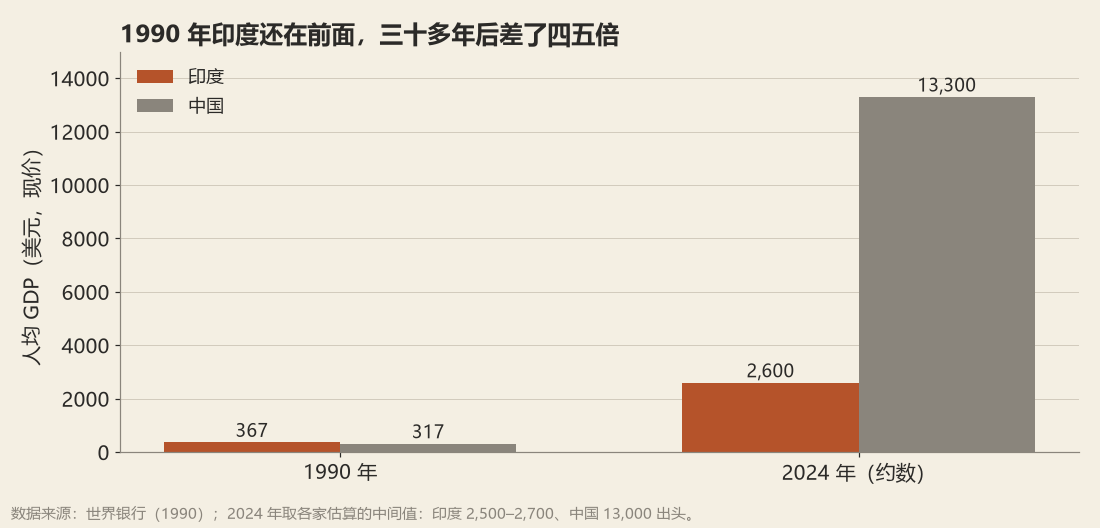
In 1990 India was still ahead; thirty-odd years later the gap is four or five times. Source: World Bank (1990); for 2024, the middle of various estimates.
By 2024 India's GDP per head was between 2,500 and 2,700 dollars, and about 2,800 is estimated for 2025; in the same period China's was a little over 13,000.
Four or five times. And this is not someone suddenly meeting bad luck; it opened bit by bit over thirty-odd years.
So the title "the stolen thirty years" is a very natural feeling: they clearly stood side by side at the start, so how, in a blink, is one already on another floor?
One word first, though: if we say "stolen," there must be a thief. I went through the possible "thieves" one by one, and found that the more respectable accounts are not about "who stole" but about "missing" and "not finishing."
First, where the gap lies
The items most often cited in comparing India and China are these.
Manufacturing. India's manufacturing has stayed between 14% and 17% of GDP for these thirty years and has never really risen. China's is about 27% (2023). In the world as a whole, China accounts for 28% to 29% of global manufacturing value added, India about 3%.
What is learned. India's education spread quickly, but how much is learned is another matter. In the 2024 Annual Status of Education Report (ASER) for rural areas: among fifth-graders, only 48.8% could read a second-grade text.
Women in the workforce. As noted in the piece on why it is so hard to be a woman in India: the participation rate of women over 15 was 41.7% in 2023–24, many of them helping on their own family's fields.
Land. The national agricultural census (2015–16) shows that the average Indian farm is only 1.08 hectares, and the marginal farms (under 1 hectare), 68.5% of all farms, average only 0.38 hectares. Small, fragmented plots make it hard for farmers to leave the land and hard for factories to get a whole block. (The piece on Indian land will go into detail.)
Several common explanations
One: a late start. China began reform and opening in 1978; India was forced to reform by the foreign-exchange crisis only in 1991, thirteen years later. This has some truth but is not enough: in 1990 the two countries' incomes per head were almost the same, which shows the gap at the start was not too large to close.
Two: the system. Some say China can concentrate its strength to get big things done, while India is a democracy where everything needs talking, quarrelling and votes. Reforms such as land acquisition and labour law really are harder in India (see the piece on land). The counter-argument: South Korea and Taiwan were not democracies in the standard sense in the key years of their industrialisation, and many East Asian economies did not stop after democratising. So the system is one factor, but hard to call the only or decisive one.
Three: taking a different road. This is the most interesting. China's road: first turn peasants into workers and get labour-intensive manufactured exports going. India's road: many bypassed manufacturing and climbed directly on services and software outsourcing (the piece on the Indian IT myth will cover this). Software created many well-paid jobs, but it needs a small number of highly educated people, and the hundreds of millions of young people with little education did not get enough jobs. In short, India leapt straight to the second floor and hardly built the stairs.
Four: timing. China joined the WTO in 2001, just in time for the wildest twenty years of globalisation, when factories were all moving there. India missed that window, and by the time it wanted to act the world had changed its rules.
Five: infrastructure and management. Power, ports, logistics, all old problems. This item is too big; one sentence will do here.
There were good chances in between
"Missing" does not mean "never moving." In these thirty years India did have several moments close to take-off:
- After 1991, loosened licensing and lower tariffs clearly raised the growth rate;
- Around 2003 to 2008 there was growth near 9% (about 9% a year in fiscal 2005 to 2008);
- The demonetisation of November 2016 and the national Goods and Services Tax of July 2017: both large reforms, both with painful side effects, and their effect is still disputed.
If we must say "stolen," the closer statement may be: every reform was done by half.
Some new things of the last two or three years
A few recent changes deserve separate mention.
- Apple's orders. In 2025 Apple assembled about 55 million iPhones in India, 53% more than 36 million in 2024, about a quarter of global output. Apple was the biggest beneficiary of the 30,000-crore-rupee mobile-phone "Production Linked Incentive" scheme (PLI) begun in 2020; its five-year term ends in March 2026, and Apple and Samsung and others are talking with the government about a new round of incentives. Phones have become one of India's biggest export categories.
- Labour law. On 21 November 2025 four new labour codes took effect at once, merging the old 29 labour laws. One provision raised the threshold above which a firm needs government approval for layoffs from 100 to 300 workers, loosening the knot for small and medium factories. Critics think this is bad for workers. (The piece on land will expand on this.)
- Free trade agreements. In January 2026 India and the European Union announced the conclusion of free trade negotiations, after almost twenty years. This pace makes the word "slow train" look quite exact.
- American tariffs. In 2025 the United States raised its tariff on Indian goods first to 25%, then doubled it to 50% (one of the reasons given was India's continued purchase of Russian oil); on 2 February 2026 the American president announced a deal with India lowering the tariff to 18%. That is the American side's announcement; I have not seen an official document with the details. And the 18% did not last long: on 20 February the US Supreme Court ruled 6 to 3 that the International Emergency Economic Powers Act (IEEPA) does not authorise the president to impose tariffs, and the reciprocal tariffs levied under that law lapsed; the same day the White House switched to Section 122 of the Trade Act of 1974, imposing a uniform 10% on all countries for up to 150 days, expiring on 24 July. What India's actual rate has been since, I have not found a reliable source; it must be checked again before publication.
Whether these count as a "new take-off" depends on whether they can be kept up over the next few years. But at least on "wanting manufacturing," policy is far more serious than before.
Indian factories in the eyes of Chinese netizens
In autumn 2026 a phrase started a quarrel on the Chinese internet: the "slave-labour theory," the claim that if workers at any link of a production line are squeezed too hard, what comes out is of "slave-labour" quality. Among thousands of discussions, India was mentioned quite often, almost always as a target: Apple leaves Chinese workers unused and moves the iPhone to India to be made, so can an iPhone made in India still be bought? Someone threw in a figure, that Foxconn's Indian workers earn about two thousand dollars a year, tens of thousands of times less than Apple's CEO (this is a netizen's claim; I have not checked it).
The quarrel itself says nothing about whether Indian factories are good, but it says one thing: in the eyes of many Chinese, India is no longer a poor neighbour who "cannot learn" but a rival that has really taken orders away.
What Indian factories are actually like: there is one thing that was seriously investigated. In June 2024 Reuters reported that Foxconn's main iPhone assembly plant in Tamil Nadu systematically did not hire married women, on the grounds that they have "heavier family burdens" and wear jewellery (a security-check nuisance). The report cited Foxconn India's former HR head, and 17 employees of a dozen recruitment agencies, and 4 current and former HR managers. Foxconn denied discriminating by marital status; Apple and Foxconn acknowledged "lapses" in 2022 hiring. India's Union labour ministry then asked the Tamil Nadu government for a report. Interestingly, Indian law itself does not forbid picking people by marital status; what governs the matter is the companies' own rules at Apple and Foxconn.
A country that wants to be "the next factory of the world" gets the orders and builds the factories, but hiring still follows the old rules: who gets in, and who stays at home.
One more number
One number has to go at the end: youth unemployment. In 2025 the unemployment rate for ages 15 to 29 was 9.9% (the official labour force survey annual report), slightly below 10.3% in 2024; for rural youth it was 8.3%, for urban youth 13.6%.
Every year several million young people enter India's labour market. If there are not enough factories, where do they go? This is the biggest bill left by these thirty years.
Turning it around
The very idea of "failing to become the next China" may itself be a problem.
First, China is a special case. A country that moves more than 25% of world manufacturing into its own house in thirty years has not appeared twice in history. With it as the reference, any country will seem to have "failed." By this standard Vietnam, Indonesia and Mexico have also "failed to become the next China."
Second, India may be taking another road. One representative of this road is digital public goods. By 2025 India's mobile payment system UPI accounted for nearly half of global real-time payment transactions (ACI Worldwide's 2024 data, cited by both the IMF and the annual report of the Reserve Bank of India, put it at 49%). No other country has this. Whether it can become a new model of growth is not yet known.
Third, "no manufacturing, no great power" may not be so absolute. In development economics there is the notion of "premature deindustrialisation" (proposed by Dani Rodrik in 2016), meaning that some countries enter the service age before finishing industrialisation. There is no precedent to check whether this pattern can sustain the prosperity of over a billion people.
If a country wants to become developed, must it first spend a period as the "world's factory"? Or can that step in fact be bypassed?
References
- World Bank, GDP per head (current US dollars): India 367 and China 317 in 1990 (cited from The Wire's relay of World Bank data)
- International Monetary Fund; UN Statistics Division/UNIDO manufacturing value added data (China about 28%–29% of the world, India about 3%)
- ASER Centre, Annual Status of Education Report (Rural) 2024
- India Agriculture Census 2015–16 (average farm size 1.08 hectares)
- Counterpoint Research, Asymco and others: iPhone output and exports in India; India's Ministry of Electronics and IT data on PLI
- India's Ministry of Labour and Employment: four labour codes in force on 21 November 2025
- European Commission, EU–India free trade agreement concluded, 29 January 2026
- India's Ministry of Statistics and Programme Implementation: PLFS annual report 2025 (youth unemployment)
- RBI: India about 49% of global real-time digital payments (2025)
- Foxconn India plant not hiring married women: Reuters investigation (June 2024), relayed by Deccan Herald, Scroll, BusinessLIVE and others; India's labour ministry asked Tamil Nadu for a report (Scroll, 2024) 🟡
- Online discussions of the "slave-labour theory" (netizens' views, used only as leads)