
How the label came about
On the night of 16 December 2012, in Delhi, a 23-year-old physiotherapy intern was attacked by six men on a moving bus and thrown from it; she died on 29 December in a hospital in Singapore. The case was called "Nirbhaya" ("the fearless one"), and there were large protests in Delhi and many cities across the country, with many young people and men among the protesters.
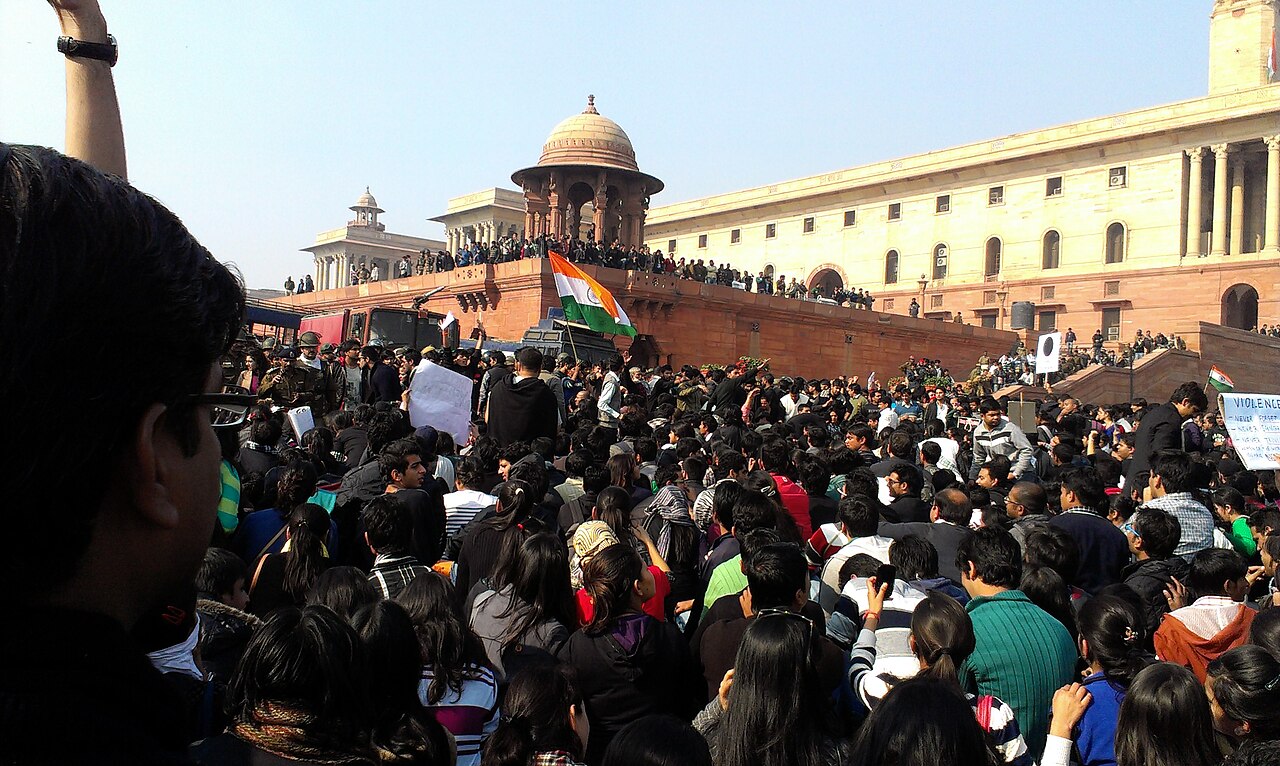
22 December 2012: students protest violence against women at Raisina Hill, Delhi. Source: Wikimedia Commons, Nilroy (Nilanjana Roy), CC BY-SA 3.0

After that a phrase appeared in the international media: "the rape capital of the world." In 2018 the Thomson Reuters Foundation ran a survey of experts and listed India as "the most dangerous country for women" (in 2011 it had ranked fourth), and the headline went round the world.
What is the relation between this label and the daily life of Indians? I want to look in three steps: what the numbers say, what they do not say, and what the real problem behind the numbers is.
What the numbers say
In the National Crime Records Bureau's (NCRB) Crime in India 2023, registered rape cases number 29,670, a rate of 4.4 per 100,000 women. Converted to per 100,000 people (men and women together), that is about 2.
In the same report, "crimes against women" total 448,211, slightly more than in 2022.
The number looks large, but looking at it alone, you can judge nothing.
What the numbers do not say: a counterintuitive comparison
If you line up the rape cases registered by police in different countries, an absurd phenomenon appears: by Eurostat's figures, in 2016 Sweden registered 64 rapes per 100,000 people, Germany 10, while India (NCRB 2023) has only about 2. Sweden, and England and Wales, ranked at the top for registered numbers in European statistics from 2013 to 2017.
Does that mean Sweden is dozens of times more dangerous than India? Of course not. The Swedish National Council for Crime Prevention (Brå) wrote a dedicated report in 2020, whose conclusion was that countries define "rape" differently in law and count and record differently, so these numbers cannot be compared directly.
A few examples of where the differences lie:
- Legal definition. In Indian law, the victim of rape can only be a woman (some countries count men as victims); many European countries also include cases where "the victim is unable to express consent," while some require violence.
- Method of recording. Sweden widened the definition of rape in 2005; and each incident is recorded separately, so that if someone reports "forced by a partner once a day for two weeks," the police record it as 14 cases. Brå's study says that if the numbers were recalculated the German way, Sweden's would fall from 64 per 100,000 to about 15, a drop of three quarters, putting it in the middle of Europe. Same country, a different ruler, and the ranking drops a long way.
- Willingness to report. The more a society encourages victims to report and the more willing police are to take cases, the higher the registered number.
So Sweden's high number does not show it is "more dangerous"; likewise India's low number does not show it is "safer."
That is to say, if the label "the most dangerous country" rests on a statistical ranking, it cannot stand. Equally untenable is "India's number is low, so there is no problem."
Where the real problem lies
The real problems are elsewhere. Several aspects say more than the numbers do.
One, how many do not dare to report. Because of social stigma, fear of reprisal and distrust of the police, many victims do not report. Scholars generally think under-reporting of rape in India is severe, but there is no reliable estimate of how much. The closest figure available comes from the fifth National Family Health Survey (NFHS-5, 2019–2021): among women who had experienced spousal violence (physical or sexual), only about 14% had sought help from anyone, and about 77% had never told anyone. This is about spousal violence, not rape, but it shows how high the share of "not saying" is.
Two, after a report is made. NCRB 2023 data show that for crimes against women, the share of cases in which the police finally filed charges (submitted a charge sheet) was 77.6%, but cases pending in court were 90.8%. The conviction rate for rape, as media quote NCRB, is 22.7% (counted on cases decided that year: of about twenty thousand decided, 4,464 ended in conviction); that is, most cases that reach trial do not end in conviction. The base of this ratio is "decided cases," not "all reports," so it should not be read as only one in five who report getting justice.
Three, acquaintances. NCRB data year after year show that in the great majority of registered rape cases the suspect is someone the victim knew (family, relatives, neighbours, colleagues), not a "stranger." In 2013, 31,807 of 33,707 cases were by acquaintances, about 94%; in 2022, 30,454 of 31,677, about 96%. This fact is very different from the international image of "a stranger on a street late at night."
Four, gaps in the law. Indian law has long had an exception for a husband raping his wife: as long as the wife is 18 or over, the husband's sexual act with her is not rape. The new criminal code in force from 2024, the Bharatiya Nyaya Sanhita (BNS), keeps this exception in section 63. The Supreme Court is examining whether it is constitutional: on 9 September 2026 a three-judge bench (including Chief Justice Surya Kant) listed the related petitions for final hearing, to begin within three weeks. This is where India differs from many countries.
What the law and society did after it happened
After the Nirbhaya case, within a week (23 December 2012) the government set up a committee headed by the retired former Chief Justice J. S. Verma, which submitted its report on 23 January 2013. In 2013 Parliament passed the Criminal Law (Amendment) Act, redefining sexual offences, widening their scope and increasing penalties, with the death penalty possible where the victim dies or is left in a vegetative state.

22 December 2012: protesting students dispersed with tear gas at Raisina Hill, Delhi. Source: Wikimedia Commons, Nilroy (Nilanjana Roy), CC BY-SA 3.0

There was a side effect that was also a good sign: after the case, registered cases rose. NCRB's numbers: 24,923 in 2012, 33,707 in 2013, up by a third and a half; Delhi alone rose from 585 to 1,441. This does not necessarily mean more crime; more likely more people reported.
On the night of 8 to 9 August 2024, at RG Kar Medical College in Kolkata, a 31-year-old woman trainee doctor was raped and murdered; doctors stopped work and took to the streets, and there were large protests across the country again. In September the West Bengal Assembly passed the Aparajita Bill, providing for the death penalty in certain cases and requiring investigations within a time limit. The Governor sent it on to the President, who, according to reports, returned it in July 2025; the Union Home Ministry thought the penalties "excessive and disproportionate" and out of step with some provisions of the new criminal code. In January 2025 the only suspect found guilty in this case was sentenced by the court to life imprisonment, not death; the Central Bureau of Investigation appealed to the High Court seeking the death penalty.
That is to say, after each big case the social reaction is strong, and each time it must face the same problem: the harsher the law is written, the slower it is enforced, and the effect may be limited.
Turning it around
This piece asks "illusion or reality," and my answer is in fact "both."
The illusion part: ranking countries by registered numbers is meaningless. The Thomson Reuters Foundation survey asked 548 experts in women's issues (aid workers, scholars, health workers, policymakers, journalists and others) to pick, among 193 UN member states, the five they thought most dangerous for women, and then to pick the worst one on each of health care, discrimination, cultural traditions, sexual violence, non-sexual violence and human trafficking. It measured experts' "perception," not incidence, and not all respondents had lived in those countries. To turn the headline of such a survey into "the most dangerous country" is itself a simplification.
The reality part: under-reporting, trial delays, low conviction rates and social stigma against victims are real. And they are not unique to India; many countries have similar problems, only to different degrees.
One more point: to turn this into "what Indian men are like" is another kind of laziness. Among those who took to the streets after the Nirbhaya case there were many men; among the doctors who stopped work after RG Kar there were also many men. The great majority of any group are not perpetrators. To put all the men of a country in one class is, like treating all the women of a country as victims, to flatten people.
When a country's numbers are taken by outsiders as a label, how should its own people respond: rebut, or admit the problem and get to work? Can the two be done at once?
References
- National Crime Records Bureau (NCRB), Crime in India 2023 (released September 2025; rape 29,670 cases, 4.4 per 100,000 women; crimes against women 448,211; charge-sheet rate 77.6%; court pendency 90.8%); the rape conviction rate of 22.7% and the number of decided cases, from Indian media reports on the report at the end of September 2025 (The Week, Deccan Herald and others)
- NCRB 2013 and 2022 reports on registered rapes and acquaintance perpetrators: 24,923 in 2012, 33,707 in 2013 (cited by LiveLaw and others); 31,677 cases in 2022, 30,454 by acquaintances (cited by media)
- Swedish National Council for Crime Prevention (Brå), Reported and cleared rapes in Europe, 30 September 2020; Eurostat 2016 registered data (Sweden 64, Germany 10 per 100,000)
- NFHS-5 (2019–2021); "Factors associated with help-seeking by women facing intimate partner violence in India," BMC Global and Public Health, 2024
- Criminal Law (Amendment) Act, 2013; Justice Verma Committee (set up 23 December 2012, report 23 January 2013), PRS Legislative Research summary
- Bharatiya Nyaya Sanhita, 2023, section 63, Exception 2; Supreme Court order of 9 September 2026 on petitions on marital rape (cited by media)
- Reports on the RG Kar case of August 2024, the Sanjay Roy judgment of January 2025, and the Aparajita Bill passed in September 2024 and returned in July 2025 (Business Standard, ETV Bharat, LiveLaw and others)
- Thomson Reuters Foundation, The World's Most Dangerous Countries for Women, 2018