How I compared
First the method; it's dull, but anyone can redo it.
I have the text of the last 28 chapters of the Guiyou manuscript, the edited text circulating online. On the other side is the last forty chapters of the Cheng-Gao edition, chapters 81 to 120 of the standard text. I removed the punctuation and marginal notes from both sides, kept only the Chinese characters, and slid a 12-character window across: wherever 12 characters in a row were exactly the same, I marked it. Then I threw out passages that appear only in the first eighty chapters, because both sides have the first eighty and they don't count.
What was left was the overlap unique to the Guiyou manuscript and the last forty chapters of the Cheng-Gao.
The result: about 2,380 characters. They are spread over 19 different chapters of the Cheng-Gao, and the longest run is 82 characters, identical on both sides.
The 1791 movable-type printing from the Cuiwen Studio, the "Cheng-jia edition." Cheng Weiyuan and Gao E printed the 120-chapter Dream of the Red Chamber for the first time; for two hundred-odd years since, people have been reading basically this edition's last forty chapters. Source: Wikimedia Commons, Library of Congress, public domain
First the limits. The Cheng-Gao text I used is the collated edition on Wikisource, whose last forty chapters are based on the Cheng-jia edition; I didn't compare Cheng-jia and Cheng-yi separately. A 12-character window misses borrowings where a few characters were changed, so the real overlap can only be larger, not smaller. I'll come back to these points later.
First, a few passages
Numbers aren't vivid, so I'll pick a few places.
Guiyou chapter 91, the confiscation of the house, has an inventory of what was seized. Chapter 105 of the Cheng-Gao has one too. In the two lists even some very obscure items are the same: twenty-three lengths of bijī (serge), twelve lengths of gurong (a woollen cloth), ten tubes of "fragrant-mouse" fur, four squares of "bean-mouse" skin. The order is the same too. What differs is that small numbers are copied as they are, and big numbers are made smaller.
Guiyou chapter 102, Miaoyu meets her fate. The plot of this chapter is Miaoyu being carried off by robbers, corresponding to chapter 112 of the Cheng-Gao. Both sides have the line "there was a rope ladder standing against the wall," and both have "her hands and feet were numb and she couldn't move, and she couldn't speak."
Guiyou chapter 83, the false Baoyu (Zhen Baoyu) returns the jade. This passage is important in the pro-authenticity argument, because the commentary notes on the first eighty chapters mention Zhen Baoyu, and the Guiyou manuscript "cashes it in."
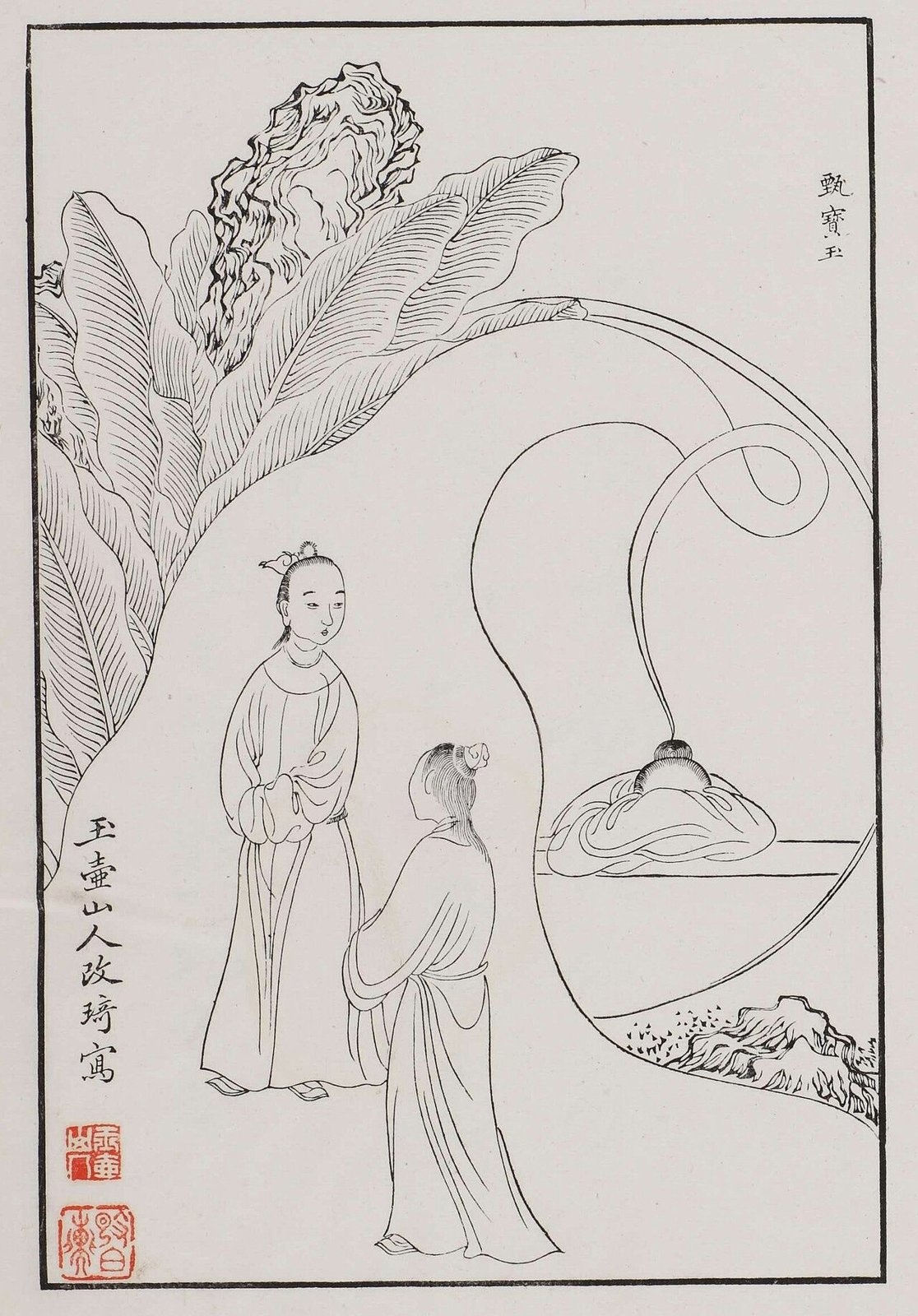
Zhen Baoyu in Gai Qi's "Illustrations of the Dream of the Red Chamber." The notes in the first eighty chapters mentioned him long ago, and readers waited two hundred years to see him meet Jia Baoyu. Source: Wikimedia Commons, painted by Gai Qi, public domain

But the dialogue in which Zhen Baoyu and Jia Baoyu meet uses the lines of Cheng-Gao chapter 115: "I have long admired your fame, but had no way to receive your teaching"; "I am utterly dull and foolish, nothing but a piece of stubborn stone."
What these few places have in common is that, in the Cheng-Gao, they are the Cheng-Gao's own plot, and the last forty chapters of the Cheng-Gao are generally thought by scholars not to have been written by Cao Xueqin.
There are two ways to read it
When two sides have large stretches of identical text, there may be three reasons.
First, the Guiyou manuscript copied the Cheng-Gao. Second, the Cheng-Gao copied the Guiyou manuscript. Third, both copied some earlier common thing.
The latter two together form the reading the pro-authenticity side needs: the editors of the Cheng-Gao had an old manuscript in hand, and the Guiyou manuscript is that old manuscript (or a close relative). Cheng Weiyuan himself said in his preface that he "searched with all his might," that "over several years only some twenty-odd juan had been gathered," and then got over ten more from a drum-seller's stall.
Has the pro side responded directly? Yes. Where people discuss online whether the Guiyou manuscript is genuine, I saw a very concentrated argument, roughly: if the Guiyou manuscript was continued by a modern person, then he copied the Cheng-Gao; but he didn't only copy, he also copied many of the Cheng-Gao's unreasonable plot points so that they became "more reasonable"; is there a plagiarist like that anywhere, in any age?
That is a very good question, because it gives a testable expectation: if a plagiarist improved things, what was moved over should be more fitting than the original.
So let's look: is what was moved over more fitting, or not?
Chapter 84: Baoyu calls his father "Mother"
First look at Cheng-Gao chapter 119, where Baoyu goes to sit the provincial examination.
In that chapter, Lady Wang says to Baoyu and Jia Lan: "You two, uncle and nephew, are both entering the examination for the first time; you've lived this long and have never left me for a day… today you each go in…" Baoyu kneels and says to Lady Wang: "Mother gave me life, and I can never repay her…" Lady Wang says: "What a pity your grandmother can't see you!"
All of this is smooth: the mother is speaking, uncle and nephew sit together, so "each go in"; Baoyu speaks to his mother, so he says "Mother."
Now look at Guiyou chapter 84, also Baoyu going to the examination.
By this time Lady Wang is already dead, in the previous chapter. So the speech is changed to Jia Zheng speaking to Baoyu. But the tone of "never left me for a day" is still a mother's tone (with maids and daughters-in-law gathered round: a father doesn't generally say this kind of thing); "today you each go in" is still there, but this time only Baoyu goes to the exam, so there is no "each"; Baoyu kneels and says to his father: "Mother gave me life, and I can never repay her." Then Jia Zheng goes on: "It's only a pity that Grandmother and your mother can't see it."
I felt a little anxious on its behalf when I read this. Three places are awkward: a father speaking for a mother, one person "each going in," a son calling his father "Mother."
Each of these three awkward points is perfectly explicable in the Cheng-Gao. Conversely, to say the Cheng-Gao was changed from the Guiyou manuscript, you must suppose that Cao Xueqin's draft happened to have these three flaws, and that the Cheng-Gao editors, by changing the plot, smoothed out these three, one by one.
Of the two explanations, one needs a single action: "when moving it, the speaker was changed and not cleanly"; the other needs a chain of coincidences. This is a very common situation in textual scholarship when judging priority: the smoother is earlier, the more awkward later.
Chapter 102: the "garden" and the "old women" in the convent
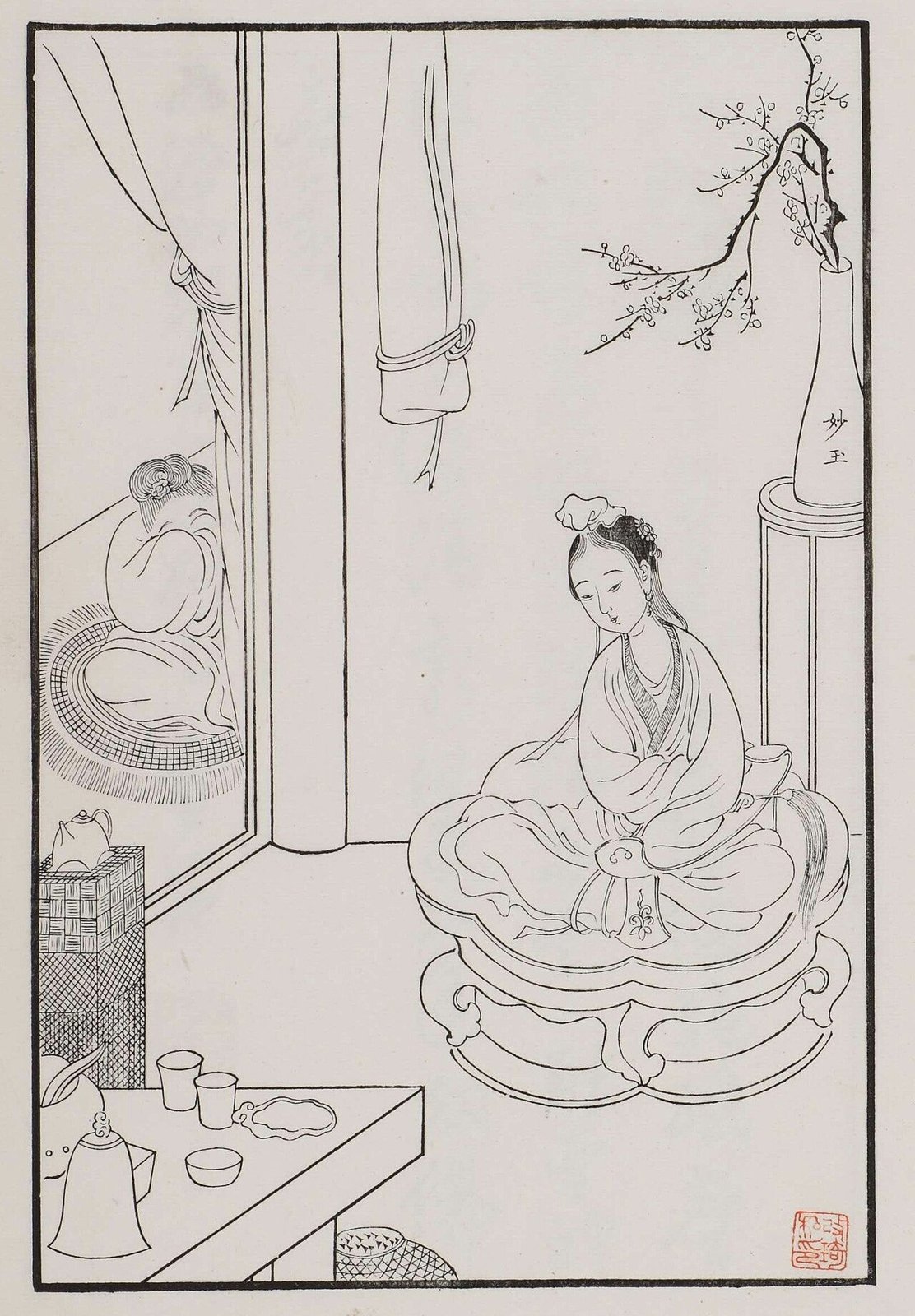
Miaoyu in Gai Qi's "Illustrations of the Dream of the Red Chamber." "She wants to be clean, but never was; she calls the void void, but may not be": the verdict already wrote her fate, but what exactly her fate was, each edition tells differently. Source: Wikimedia Commons, painted by Gai Qi, public domain

The second place is Miaoyu.
In Cheng-Gao chapter 112, Miaoyu lives in the Hall of Green Jade (Longcui Nunnery) inside the Grand View Garden. The robbers climb in from the garden's back wall, put up a rope ladder, and climb out, with accomplices waiting outside. The next day the nuns discover she's gone, and "the old women and maids all said."
In Guiyou chapter 102, Miaoyu has already left the Jia household and lives in a small nunnery by the Guazhou ferry, with only an old nun, a young nun and two maids. But in the story, the monks still "came to the garden's back wall, put up a rope ladder, climbed up the wall and jumped out," the next day still "opened the nunnery door and searched the whole garden," and still a crowd of "old women" appear whom the earlier text never mentioned.
The garden and the old women of the Grand View Garden, moved into a small nunnery at a ferry crossing, become surplus things.
If it's "not cleanly changed," what does that mean?
Put these two places together, and neither is "changed to fit better"; both are "moved over, scene changed, the old things left uncleared."
This cannot prove that the Guiyou manuscript certainly comes from 2008. What it proves is narrower: at least in these passages, the Guiyou manuscript is downstream of the Cheng-Gao. The Cheng-Gao was printed in 1791.
A few more limits need adding, and I want to be clear about them.
First, this is only a few passages. The 2,380 characters I mention are only part of 28 chapters. What the rest comes from, this comparison can't say.
Second, what I compared is the text circulating online and the publisher's edited version; I have never seen a physical object. The publisher's own preface admits that this book is "an edited version of images of a copied manuscript, not the text of a true copy." (Publishers: Jin Junjun and He Xuanhe, 2017 preface.)
Third, in 2018 Guangming Daily relayed the promoter's 2014 account: the 28 chapters circulating online were "reconstructed from memory" by him, and later revised many times by him and by others. If that is true, then the "text in memory" itself may have mixed in sentences from the standard edition. I can't judge this, and can only leave it here for now.
My view
I still think the Guiyou manuscript is an earlier draft, not yet polished. As for "has not been tampered with," my current formulation is: its main skeleton has not been tampered with, and later people have added to it.
I have an image for this: beauty lies in the bones, not the skin. The words don't matter; the skeleton does.
By that image, what I'm holding on to is the skeleton: the direction of the plot, the ends of the characters, the structure of echoes forward and back. The skin, the wording sentence by sentence, can be added by later hands, or can have grown in copying; it is not what I'm defending.
I lean towards thinking the skeleton is genuine, and my reason is purpose: it writes about home and country, which is higher than writing about a family or about romantic love.
I know what kind of reason that is. It is one reader's judgment, not textual-scholarship evidence: a high purpose can show that this skeleton deserves to be taken seriously, but cannot by itself show which era or which person it comes from. Likewise, a modern person who has read the allegorical school, writing along the "home and country" route, would also have a high purpose. So I treat it as a leaning, not a proof, and won't use it to rebut any test of wording.
How does this line up with the evidence in this piece?
The two thousand four hundred characters that overlap with the Cheng-Gao are skin. I counted: the whole 28 chapters come to about 190,000 characters, the overlap is 1.3 percent, concentrated in places like chapters 83 to 86, chapter 91 and chapter 102. Baoyu calling his father "Mother" in chapter 84, and the extra "garden" and "old women" in the convent in chapter 102, are all traces on the skin. What they show is that the wording of these sentences comes after the Cheng-Gao. They don't touch the skeleton.
Rhyme is skin too. Daiyu's "Ten Poems of Solitude" in chapter 82 rhyme by modern standard Mandarin, which shows that the wording of those poems was written by a modern person. As for the skeleton, the plot of the "Ten Poems of Solitude" in this chapter was mentioned in the notes to the first eighty chapters, and the skeleton can be early.
So, by "the bones stay, the skin doesn't matter," both groups of evidence in this piece strike the skin and not the bones.
But in saying so, three things have to follow:
First, what could prove the skeleton? The evidence the pro side gives now is "fitting": foreshadowing that lines up, symmetrical structure, consistent characters. But I explained in another piece that the notes of the first eighty chapters were long ago compiled into a public list, and writing along the list also lines up. So what "fitting" can prove is that the writer had read that list; it can't alone prove the skeleton belongs to Cao Xueqin's generation.
Second, the line between bone and skin has to be drawable. Which is bone and which is skin can't be "what agrees with me is bone, and what doesn't is skin." If it can't be drawn, then the claim can't be overturned by any evidence.
Third, this is a claim that can't be tested by wording. All tests of wording, the Cheng-Gao overlap, the rhyming, the traces of moving, can't touch it. There is only one way to overturn it: a physical manuscript appears, or an independent record from before 2008 that has nothing to do with the promoter. So far there is neither.
One last question
Whichever way you take it, there is one question I still haven't worked out.
If the Cheng-Gao editors really had an old manuscript in hand, why are the sentences they chose exactly the smoothest ones in the Cheng-Gao's own plot? If the Guiyou manuscript copied the Cheng-Gao, why is the copying so fragmentary, scattered across 19 chapters?
Which of these two situations do you think is more like what a person does when copying a book?
References
- Liu Jian, "The Collapse of 'Wu's Story of the Stone,'" Guangming Daily, 27 February 2018
- Preface to The Last 28 Chapters of the Guiyou Manuscript of the Story of the Stone, Jin Junjun and He Xuanhe, 10 April 2017; preface one to the third edition, Xiao Wenlin, 8 April 2017
- Online discussions about whether the Guiyou manuscript is genuine (netizens' views, as leads)
- Wikisource collated edition of Dream of the Red Chamber (first eighty chapters on the Gengchen manuscript, last forty on the Cheng-jia edition); Cheng Weiyuan's preface: "Preface by Cheng Weiyuan" in Wikisource's Dream of the Red Chamber (Cheng-yi edition) (signed Xiaoquan Cheng Weiyuan)
- The author's own character-by-character comparison (12-character window; details not published)
- Image sources are given in each caption