
First, what this line says
"There's no throne to inherit."
The meaning: you have children so there is someone to take over, to carry on the family estate. If your family has no estate, no "seat," there is no reason to have many.
Who said it first, I have not found. It sounds like a joke, but I think it is actually a very serious algorithm: it treats a child as an investment and looks at the return.
So let us work it out by its own algorithm.
The half it gets right
Start with money. In February 2024 YuWa Population Research (a private demographic think tank) issued a report: for Chinese families, raising a child from birth to age 17 costs 538,000 yuan on average; to a university bachelor's degree, about 680,000 yuan.
It also computed a multiple: the cost to age 18 is 6.3 times GDP per head. Compared with other countries: Australia 2.08 times, France 2.24, Sweden 2.91, Germany 3.64, the US 4.11, Japan 4.26.
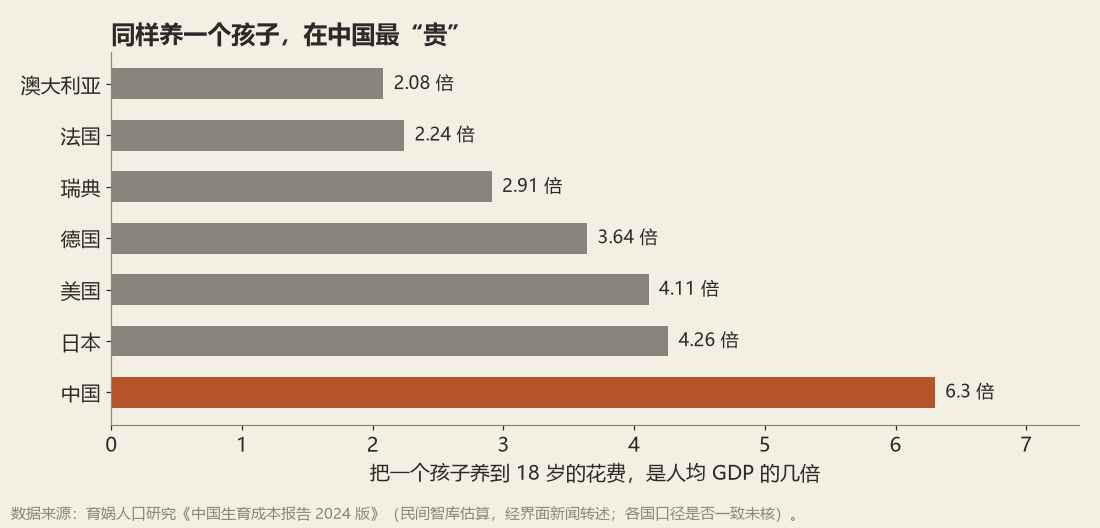
Source: YuWa Population Research, China Fertility Cost Report 2024. This is a think tank's estimate, not official statistics; whether the definitions are consistent across countries I have not checked.
The report has one more item, the "mother's price": for each additional child, women's wage rates fall 12% to 17%; the Western figure it compared with is about 7%.
For the new 2026 edition (using 2024 figures), what I read is media accounts of the report: from preparing for pregnancy to age 18, an average of 2,544 yuan a month; a second child costs about seventy percent of the first, a third about sixty percent.
Korea's figures point the same way. A 2024 survey of Korean newlyweds: raising one child for 19 years was estimated at 252 million won, about 1.4 million won of childcare costs a month on average.
Then happiness. Some have made meta-analyses of children and well-being. The abstract I read says: on happiness measures such as "life satisfaction," parents and the childless hardly differ; on measures such as "whether life has meaning," parents are slightly higher, more clearly for women; on marital satisfaction, parents are lower than the childless, and the more children the lower.
In 2014 Angus Deaton of Princeton and Arthur Stone of Stony Brook, using Gallup survey data (published in PNAS), also said: once marriage, income, education and religion are controlled, the overall life satisfaction of parents and non-parents differs little.
Economics has an old idea, the "quantity-quality trade-off" (Becker and Lewis, 1973): the richer a family, the more it wants to give each child better conditions; once the standard of "better" is raised, the cost of each child goes up, and so there are fewer children.
So counting only the account of one household, the quip stands. A child is something you spend on, not something that brings income in. As for being happy, the research says "about the same."
What it leaves out
First, most families never had a throne.
Historically, the great majority of people did not have children in order to take over a seat either.
Mencius, "Li Lou I," has a line: "There are three kinds of unfilial conduct, and having no heir is the greatest." For over two thousand years there was not a single throne in that sentence. What it speaks of is "heir": someone to carry on.
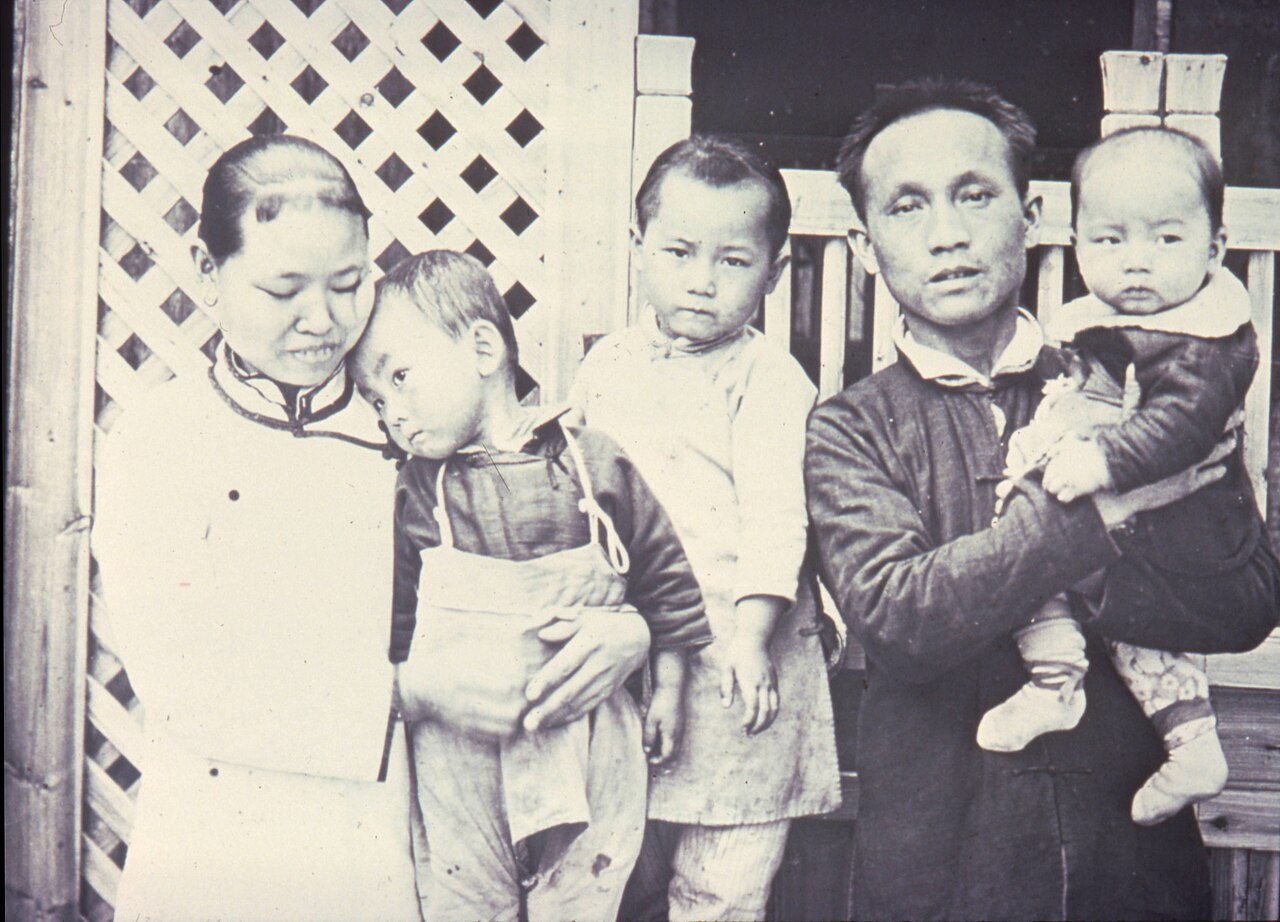
A gatekeeper and his family, Changde, Hunan, c. 1900–1919. A gatekeeper's household has no throne, yet it has three children. Source: Wikimedia Commons, anonymous, public domain

Carry on what? Fields, house, a trade, incense, and one more thing: after you are old, someone to look after you.
For that last item, there are still numbers today. In the long form of the 2020 Seventh Census, the main source of living for rural people aged 60 and over was: support from family 41.9%, own labour 33.6%, pension only 10.4%. In the city it is just the reverse: pension 69.8%, family support 17.3%. (This is a sample table; I use only the proportions, and went into detail in the piece "Where Does the Money Come from When You Are Old.")
So the metaphor of the "throne" makes the reason for having children too narrow. For most people, children are not for "taking over a seat" but for "keeping on caring."
Second, the account is recorded somewhere else.
With institutions such as pensions, "someone looks after you when you are old" no longer depends only on your own children. It depends on this: those now at work pay in and support today's old. What you pay supports other people's parents; when you are old, it is other people's children who support you.
In such a system, part of a child's "returns" is shared among everyone, while the cost is borne only by the parents. Economics calls this an "externality." Economists have written that under pay-as-you-go pensions, whether a couple has a child affects everyone's pension, yet nobody takes that into their own decision, so the result tends to be too few children; much of the literature calls this the "externality" of fertility and holds it to be positive. At the same time it gives every couple a reason to free-ride. (This is from my reading of literature reviews; I did not read the papers one by one.)
The numbers are here: in 2025 China had 7.92 million births and 11.31 million deaths; people aged 60 and over numbered 323 million, and those aged 65 and over 224 million. (National Bureau of Statistics, January 2026.)
This "externality" does not rebut the quip but supplements it: the private account is negative, the social account positive. So some are unwilling to pay, and some feel somebody has to.
Third, what people want and what they actually have differ.
A 2024 Korean survey asked working women aged 25 to 45: 66.9% said two children is ideal, 19.2% one, 10.1% three. But among the same people, more than sixty percent had no plan to have a child.
Asked why not: the most common answer was "I don't think it's necessary" (13.9%), then "not enough economic means" (12.7%) and "education costs too high" (10.7%). Among the married, "I don't think it's necessary" was 19.1% and "I don't want to spend that much time and energy" 11.8%.
My reading is: some do not want one; some want one but not at this price. How big each part is, the statistics cannot separate.
Chinese figures I did not get. The China Population and Development Research Center under the National Health Commission began a national survey of 30,000 people in October 2024; the results have not been seen.
How other places answer
I set out how other places answer "the reason for children."
Israel, with a total fertility rate of 2.87 in 2024, is the only OECD country above replacement level. The differences within are large: the ultra-Orthodox about 6.5 (official figures for 2020–22), secular Jews about 2.1 (the 2014 figure cited in one study); for the religious but not extreme band I have no reliable figure.
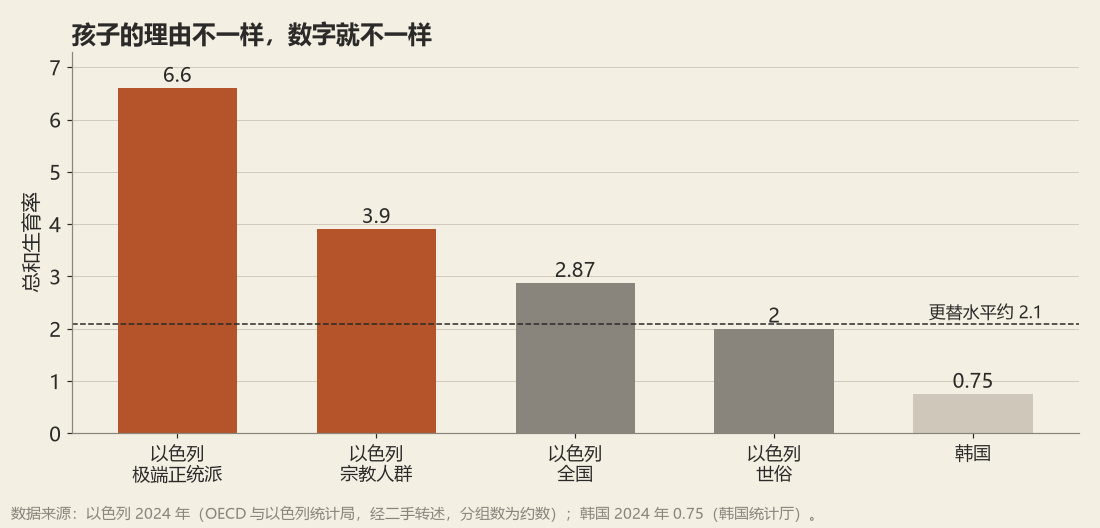
Sources: Israel 2024 (OECD and Israel's Central Bureau of Statistics, relayed second-hand, group figures approximate); South Korea 2024 (Statistics Korea).
There, "the reason for children" is neither taking over a seat nor old-age support, but a community going on down the road: children are part of the "teaching." There is another side: the secular Jews' 2.0 is also higher than most developed countries, and research often attributes it to state policy (such as publicly funded IVF) and the security situation, not wholly to religion; and the figures for these groups cannot be used directly to say "religion makes people have more."
South Korea, in 2025, had a preliminary total fertility rate of 0.80 against 0.75 in 2024; births in 2025 were 254,500, 6.8% more than the year before. Whether the rise is a rebound of those who married after the pandemic, or policy at work, or both, accounts differ.
"Can giving money make people have more?" The evidence from various countries I will devote a separate piece to later.
Turning it around
In this section I want to reverse my own argument too.
First, "the social account is positive" does not lead to "you should have children." The externality reasoning works in reverse too: since the benefits are everyone's, the costs should be borne by everyone, not all pressed onto the parents. Whether having children is a public or a private matter, countries' practices go both ways.
Second, research on happiness does not support "children make you happier." Several items above all say "about the same." On whether childless old people are lonely, studies also say different things: one US study in 2025, the average loneliness score of childless old people was 1.62, of those with at least one child 1.52; but where friends give strong support, the loneliness of the childless drops more. Other research says being childless is not necessarily lonelier in itself; it depends on why. These are press releases and abstracts, with American and European samples, not Chinese. So "someone looks after you when you are old" is a reason beyond the throne, but "no children means loneliness" the data do not support.
Third, some count from the other end. In 2011 the economist Caplan wrote Selfish Reasons to Have More Kids, saying that studies of twins and adoption show that within the normal range, how parents raise children affects how they turn out less than people think, so there is no need to be so anxious about raising them and the cost can be lower. This claim is very controversial; I did not read the book, only reviews.
Fourth, how many is "so many"? At present there are 7.92 million births a year, which is hardly "so many." What is really in dispute is often not three or two but none or one.
My leaning
I am not angry when I hear this quip; I even think its sums are right. It is only that the book it keeps is too small.
It shrinks the child into a piece of private property: taking over a seat, an estate, money. Counted that way, it is of course not worth it. What I myself worry about most is children and the birth rate. Put larger, it is the future of the yellow peoples; every series I write goes round and round to this one thing.
The word "heir" has never meant only an inheritor. A person lives in a community with a past, ancestors ahead, children behind, himself standing in the middle: that is what it means to "have heirs." I have looked at Israel's numbers seriously: the same country, the same era, the same house prices, and religious families have two or three times as many children as secular ones. I am not saying religion is the answer; Malaysian Indians are religious too and their fertility is just as low, 1.1, which is a test of my view. But one thing I am more and more sure of: after industrialisation people were taken apart one by one, atomised, and only then did a child become an "unprofitable investment." What is lacking is not money but something that can join people up. What I call the "core" is just this: a cultural faith everyone recognises, which lets a person feel "I have a past and a place to go" (ancestor worship, rites, festivals, Chinese characters one can read), not anyone's national identity. What it cures first is "not standing firm"; the fertility rate is something that may follow back once people stand firm.
There is one more layer, how a family divides its work. The report says that having one more child lowers the mother's wage rate by 12% to 17%. My view is that a family should be complementary: if the woman is strong she can take the outside; then find a man who by temperament does not compete to be strong and have him run the back yard well. Who takes the outside and who the inside is divided by temperament, not by sex. In this way that cost need not always be counted on the mother's head alone.
So I do not rebut the quip. I only want to ask: besides each household's own books, should a society have another set?
There was no throne in your family. Then why did your parents have you?
References
Ratings: 🟢 original read; 🟡 second-hand; 🔴 only the abstract read.
- YuWa Population Research, China Fertility Cost Report 2024 edition, 2024-02-21 (relayed by Jiemian News) 🟡; 2026 edition (released 2026-05-29, 2024 figures: 2,543.84 yuan a month per child, 580,000 yuan cumulative; second child about 70% of the first, third about 60%; relayed by NetEase, Jiemian, Caixin and others) 🟡
- Survey of childcare costs of Korean newlyweds (Korea Times 2024-03) 🟡; survey of working Korean women aged 25–45 on childbearing (2024-02) 🟡
- Deaton & Stone, PNAS, 2014 (Gallup data; with marriage, income, education and religion controlled, little difference in life evaluation between parents and non-parents), per Pew Research's 2014 relay and media reports 🟡; a meta-analysis of the well-being of parents and non-parents (abstract) 🔴
- Studies of loneliness among childless older people (UNH press release 2025, US; abstracts of European studies) 🟡
- The China Population and Development Research Center's national survey on fertility intentions (launched 2024-10, relayed by China Daily; results not out) 🟡
- Mencius, "Li Lou I," "There are three kinds of unfilial conduct, and having no heir is the greatest" (Wikisource) 🟢
- Becker & Lewis (1973); the fertility externality under pay-as-you-go pensions (a series of papers by Cremer, Gahvari, Pestieau, Meier & Wrede and others, per literature reviews and working-paper abstracts) 🟡; Caplan, Selfish Reasons to Have More Kids (2011) (relayed by reviews) 🟡
- National Bureau of Statistics 2025 population data (released 2026-01) 🟢
- Seventh National Population Census long form, tables 8-4a/b/c, main source of living of those aged 60 and over 🟢
- Israel's 2024 total fertility rate 2.87 (media relay) 🟡; ultra-Orthodox about 6.5 (Okun, "Faith & Fertility in Israel," SAPIR, 2024; Foreign Policy, 2025-05-14, citing 6.48 in the official 2020–22 figures) 🟡; secular Jewish women about 2.1 (one study citing the 2014 figure) 🟡; Statistics Korea birth statistics for 2024 and 2025 🟡
- For comparison: this series' "Where Does the Money Come from When You Are Old"; the Neighbours' Heaven pieces "Six Similar Exam Papers" and "The Same Deck, Six Ways of Playing"