Let's start with hair
In early May 1644, the Qing army entered Beijing. Within days, the regent Dorgon issued an order: every surrendered official, soldier and commoner must shave his head, and "dress and cap shall all follow the dynasty's rules."
Less than a month later, on the twenty-fourth day of the fifth month, he took it back. From now on, he said, "the people of the realm may keep their hair tied up as before, as they please." Most likely the backlash was too strong, and he had only just arrived and wasn't yet on firm ground.
But the next year, in the sixth month, just after Nanjing fell, the order came again, and this time the words were hard: "All civil and military officials and all people everywhere must shave their heads. Whoever does not comply will be dealt with under military law." This time it was never withdrawn.
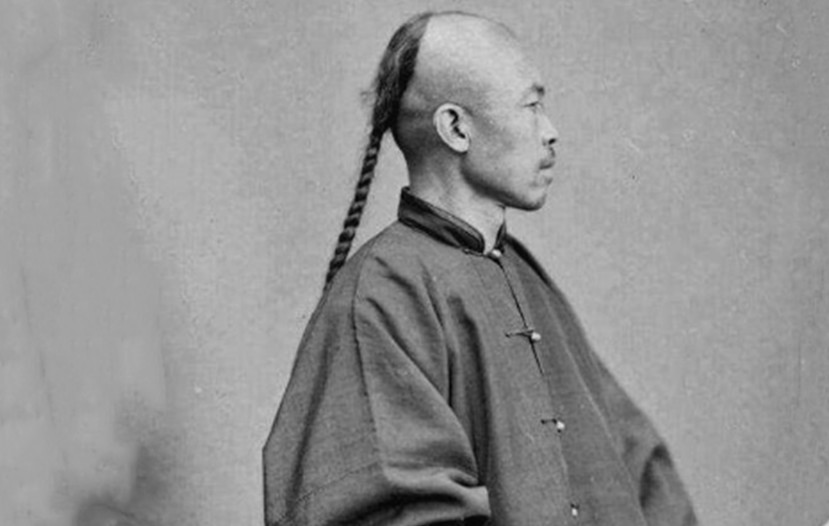
An old photograph from the Qing: the forehead shaved, one braid down the back. This is what the Queue Order wanted every man to become. Source: Wikimedia Commons, anonymous, public domain

Two hundred years later, it was the classics' turn
Jump forward two centuries. In 1853 the Taiping Heavenly Kingdom made Nanjing its capital and renamed it "Heavenly Capital." That year it printed a small booklet, On the Decree to Seal and Promulgate the Books. It ruled that only three books in the world were proper books: the Old Testament, the New Testament, and the Heavenly King's own decrees. As for the rest: "All the demonic writings and heresies of Confucius, Mencius, and the hundred schools are to be burned in full."
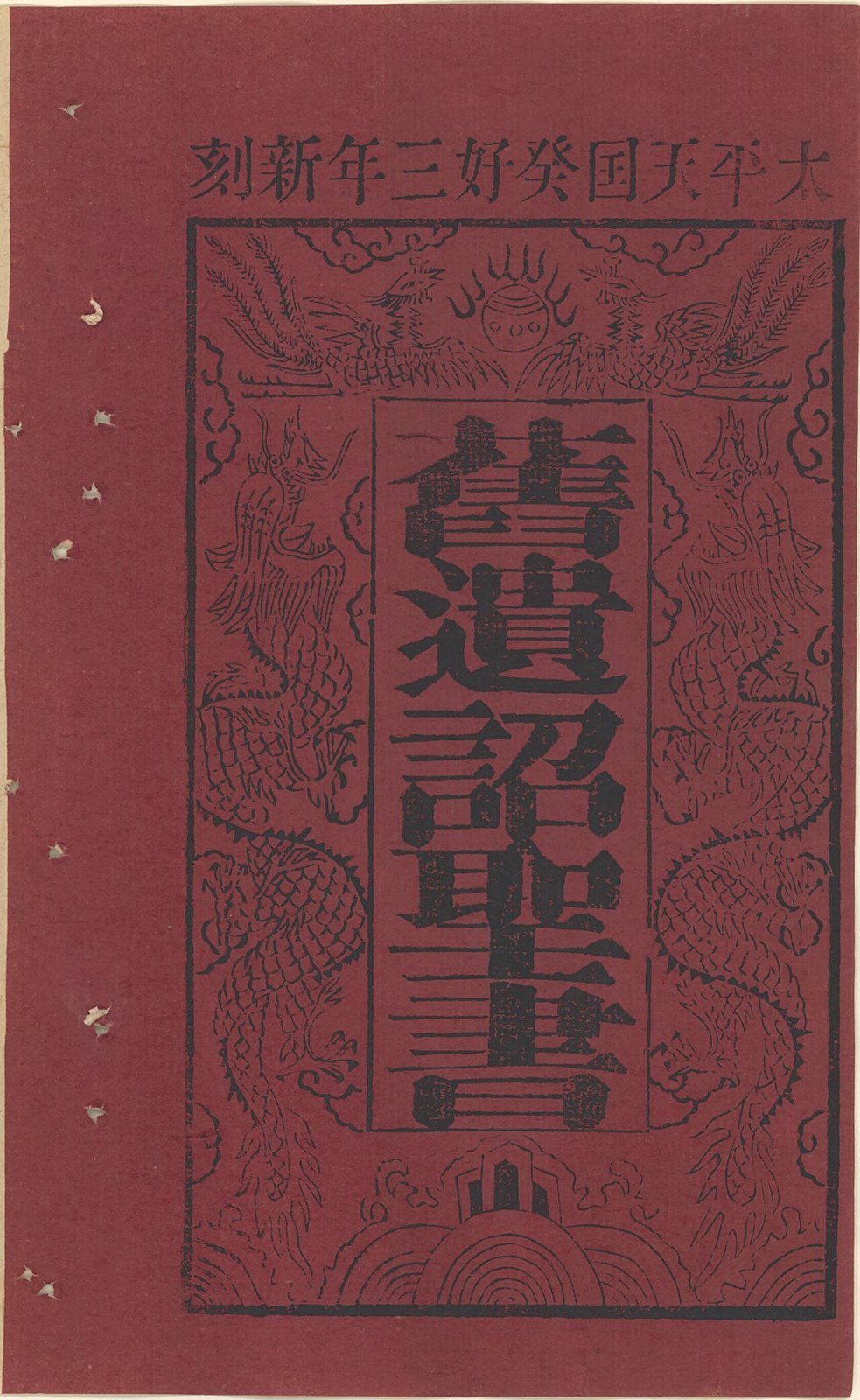
Cover of the Old Testament printed by the Taiping Heavenly Kingdom, marked "newly cut in the third year of Taiping, Guihao." This is the kind of "proper book" they left behind. Source: Wikimedia Commons, anonymous, public domain

The next year, in the first month, Zeng Guofan led his Hunan Army out of Hunan and issued a manifesto, the famous Proclamation Against the Guangdong Bandits. He accused the Taipings of sweeping away, in one stroke, "the rites and human bonds of China's thousands of years, the norms of the Odes and the Documents," and called it "the strangest upheaval of the moral order since the world began." (The "moral order" is mingjiao: the web of roles and duties, ruler and subject, father and son.)
What's interesting is the second half. He doesn't speak only for Confucius. He speaks for Guan Di, for Yue Fei, for Buddhist temples, Daoist halls, city gods and village altars. In his words: "The kingly way governs the visible; the way of the spirits governs the unseen." A Neo-Confucian scholar, in the most important manifesto of his life, standing up for the city god and the earth god. I have always found that detail rather delightful.
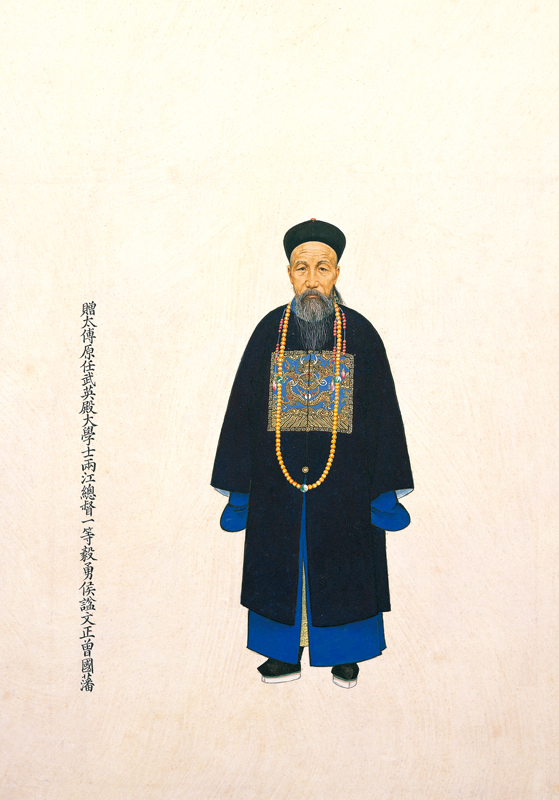
Zeng Guofan, from "Portraits of Meritorious Officials Who Pacified the Guangdong Bandits." Source: Wikimedia Commons, anonymous, public domain

Then the country was restored
On 15 February 1912, Sun Yat-sen (Sun Wen), as provisional president, went to the Ming Xiaoling tomb in Nanjing to report to the first Ming emperor. His opening line:
"It has been 267 years since the Ming lost its sacrifices. The Republic of China was founded, and forty-two days later the Qing emperor abdicated and the republic was firmly established…"
It was a way of giving the Ming an account of what had happened.
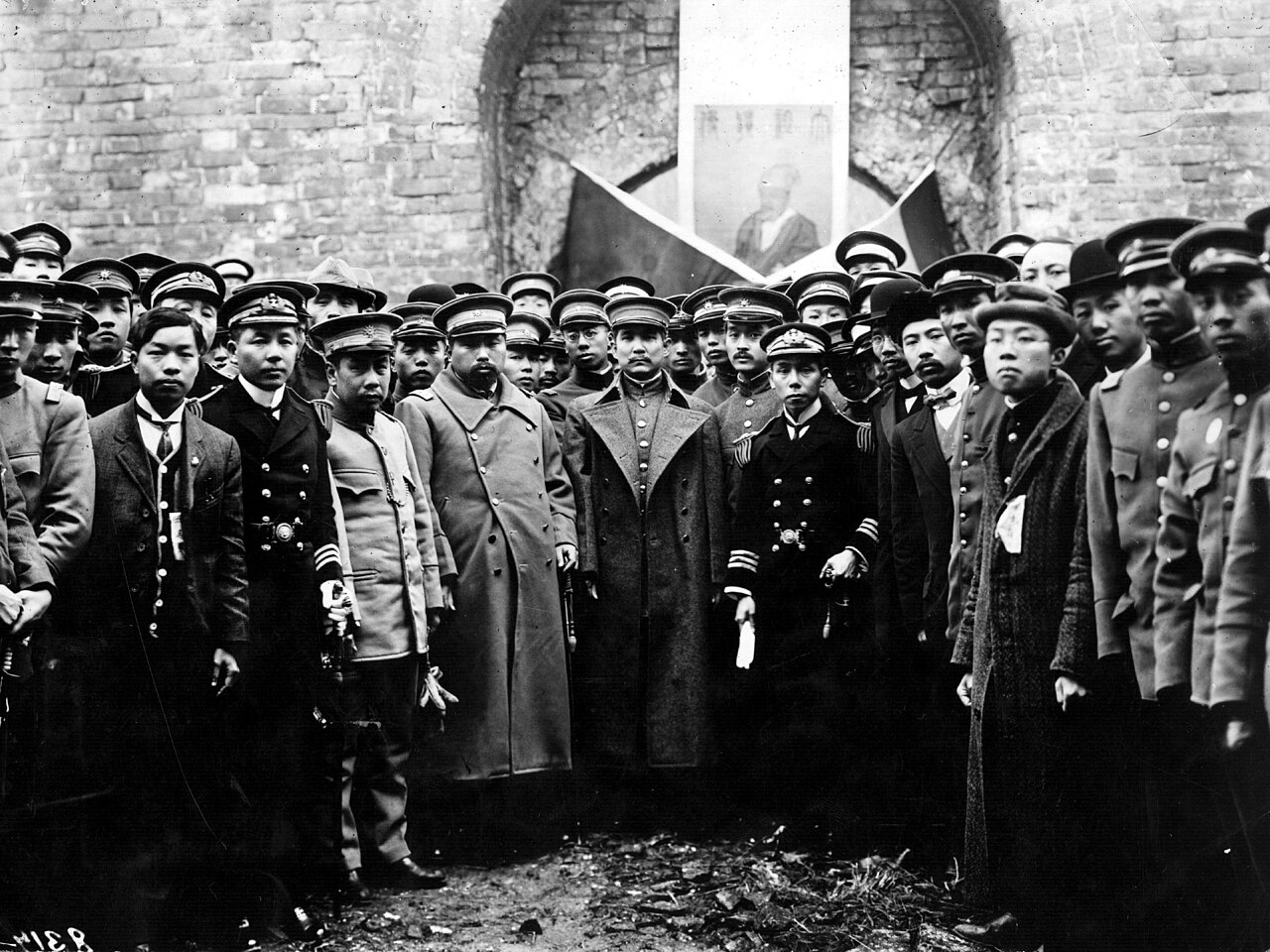
Sun Yat-sen with civil and military officials of the Nanjing provisional government at the Ming Xiaoling, 15 February 1912. Sun is seventh from the left in the front row. Source: Wikimedia Commons, photographed by Tongsheng Studio, Shanghai, public domain

But think about it. The country was restored. The shaved hair was not grown back by anyone, and the burned books were not replaced. That same year the Republic's slogan changed from "expel the Tatars" to "five peoples in one republic." Restoring a country and restoring a yigui — something to rely on and return to — turn out to be two different things.
In the early Republic, someone really tried
Yet right then, some people began trying to build that yigui, and they did it seriously.
On 7 October 1912, Confucius's birthday, Chen Huanzhang founded the Confucian Association in Shanghai. Only fifty or sixty people are said to have attended, and they performed the three kneelings and nine kowtows. Later it grew a three-tier structure of headquarters, offices and branches, published the Confucian Association Magazine, and in September 1913 held the first national Confucian congress in Qufu. After that it met every year on Confucius's birthday, until the last one in 1930. How many branches there were, sources disagree: anything from a hundred and thirty-odd to nearly three hundred. Many researchers think the association took Christianity as its model.
In the summer of 1913 they sent a petition to Parliament asking that Confucianism be written into the constitution as the state religion. Their reasoning was plain: China had always honoured Confucius, and had always allowed freedom of belief; both were unwritten constitutions that had run for thousands of years without a fight, so writing them down would merely record what already existed. The signers included Chen Huanzhang, Yan Fu, Xia Zengyou and Liang Qichao.
Most members of Parliament said no. The constitution already guaranteed freedom of religion, and setting up a state religion on top of that would make the clauses fight each other. The 1913 Temple of Heaven Draft Constitution kept only one sentence: "National education takes the Way of Confucius as the foundation of self-cultivation." In 1916 Kang Youwei stepped forward again, demanding that "Confucius be made the great religion and written into the constitution," and Chen Duxiu answered him: "Not to sacrifice to Confucius is to break the law; to sacrifice to Confucius is to betray the religion. There is no way out either way." In 1917 the constitutional review committee settled on something else: the people of the Republic of China are free to revere Confucius and free to believe in any religion. Confucius and freedom of religion sat side by side. Confucianism never became the state religion.
One thing is easy to get backwards: Yuan Shikai did not back the Confucian Association. He honoured Confucius and held the rites, but he openly opposed a state religion, and even said Confucius was "never really a religious figure." Those who wanted to borrow Confucius's authority were also afraid of the words "state religion." In 1917 Zhang Xun attempted a restoration, and Kang Youwei took office in the "new dynasty." When the restoration collapsed, the Confucian Association carried the stain of "restorationism" with it.
What I think matters most in this story is that the Confucian Association really built only two things: rites (the Confucius ceremonies, the congresses) and a press. Weekly gatherings, membership rolls, daily practices handed down generation after generation: I haven't found any. The kind of "church" Kang Youwei had imagined, it never managed to build itself. So the Confucian Association's failure only shows that one version failed: relying on the state, relying on a constitution, tied to the monarchy, with no daily congregation. It does not let us conclude that "Confucianism cannot become a religion."
All-under-Heaven, or the state?
I have to stop here for a moment, because the word "country" has been slipping in the sections above.
Gu Yanwu drew a sharp line between "state" and "all-under-Heaven (Tianxia)" (there will be a whole piece on that later). But by the time of Sun's visit to the tomb and the Confucian Association's petition, nearly everyone was talking about the "state": the country restored, a state religion, citizens of the nation. In his 1899 On Loving the Country, Liang Qichao said that Chinese people called their land "all-under-Heaven," not "a state."
So there is one question I'll keep asking in this series: is the unit of a civilization really the state?
My own answer is: all-under-Heaven stands beside civilization, and a religious community is the vehicle.
Let me spell that out. Tianxia governs range and order: who is inside a circle, and what draws the circle. Huaxia civilization had an old tradition: a feudal lord who adopted barbarian rites was treated as a barbarian, and one who learned the rites of China was treated as Chinese. Han Yu says in his On the Origin of the Way that this is exactly the brush of the Spring and Autumn Annals. The circle is drawn by culture, not by blood. Civilization governs continuity of content: characters, rites, classics, the calendar, festivals. Both have to travel a long way over a long time, and something has to carry them. I think that something is a religious community. The Jews had no state of their own and travelled for nearly two thousand years. The caliphate ended in 1924, and Islam did not scatter with it. Neither relied on a state. The state is a fairly recent form, and treating it as the unit of a civilization takes something fairly new and mistakes it for something eternal.
Three answers
Put those years side by side, and I think they are all answering one question: what, in the end, holds a people together?
Over three hundred years, roughly three answers have appeared.
The first is dress. Hairstyle, clothing, ritual: you can tell at a glance who someone is. The Queue Order of 1645 went straight at this.
The second is mingjiao, the moral order. No particular god to worship; just hold on to the web of human bonds, ruler and subject, father and son, benevolence, rightness, propriety, wisdom. This is what Zeng Guofan fought to defend, and when Gu Yanwu spoke of "the fall of all-under-Heaven," this is what he meant.
The third is religion: a yigui that people really believe in. Hong Xiuquan wanted this. He found the two characters for "Shangdi" in the Book of Odes, and then turned around and wanted to burn Confucius and Mencius. In the Republic, Kang Youwei wanted this too, hoping to write the Confucian religion into the constitution, and Chen Duxiu answered with a single line: "To sacrifice to Confucius is to betray the religion." The Confucian Association in the section above was the most serious attempt at this third answer.
In 1924 Sun Yat-sen offered one more. Foreigners say the Chinese are "a sheet of loose sand," he said, and the prescription he gave was to start from clan and native place and link people up layer by layer.
Honestly, none of these answers was kept whole.
My leaning
Let me put my own leaning on the table first.
Robes and caps, the clothing of the people, were once the yigui of Huaxia. After 1644 they were destroyed.
The "Celestial Court" (Tianchao) was also a yigui in the traditional Huaxia story. Its effect on its neighbours was one of lowering the dimension: Korea and Vietnam were both deeply shaped by it. Because the influence went so deep, after the Ming fell Korea called itself "Little China" and did not recognise the Qing as China. As I read it, Vietnam had a similar idea; I haven't checked the details yet.
In other words, the yigui belongs to Huaxia, not to whichever dynasty happens to sit in Beijing.
And for a civilization to really hold its people together, it ultimately needs a real religion.
My aim in writing this series is to awaken the Han, so that in the end they might stand shoulder to shoulder with the Jews.
That is my position. In this series I will look for evidence for it, one piece at a time, and also look for the strongest opposing case, one piece at a time.
I want to be clear about the words "a real religion," so no one misreads them. What I want is not a national identity, not "we are one race." National identities can go their own ways; that's fine. What I want is one shared set of cultural beliefs for everyday life: ancestral rites at Qingming, the festivals of the year, courtesy in how things are done, rules for how we dress, and being able to read what is written in Chinese characters. With such a set, whichever country you live in, whichever passport you hold, you recognise your own people at a glance. How did the Jews travel for two thousand years? Not on a state, but on the Sabbath, food rules, scriptures and the synagogue, things done every single day. That is what I want.
Also, the people this site wants to talk to are not only Chinese. The Korean peninsula, Japan, Vietnam, the Ryukyus, and East Asians scattered around the world use Chinese characters, keep the same festivals and remember the same ancestors. For them this question is just as unavoidable. Someone asked me who I'm really writing for. I'm writing for every East Asian who has ever thought about this question.
How this series will be written
The series is called Yigui: China's Heavenly Kingdom and All-Under-Heaven. (Yigui is a belief to rely on and return to.)
"The Heavenly Kingdom" is Hong Xiuquan's. Most religions promise a heaven after death, but Hong promised one on earth, to be built as soon as Nanjing was taken. And he was not the last to promise it. About seventy years later, a doctrine from the West also promised the Chinese a heavenly kingdom, again not after death but in the human world, in the future. This series will talk about both of these kingdoms.
"All-under-Heaven" is Gu Yanwu's and Zeng Guofan's. For three hundred years, Chinese people have more or less walked back and forth between these two poles, "Heavenly Kingdom" and "All-under-Heaven."
I'll start in 1644 and run to the present, and look a little ahead too. Each piece takes one small detail: a character, an order, a manifesto, a constitutional clause, or a sentence that someone deleted.
I've set myself three rules.
First, every quotation has a source, listed at the end. If I can find the original book, I use it; if I can only find it quoted by someone else, I say so honestly; if I can't find a source, I leave it out, however good it sounds.
Second, every piece has a section called "Looking the Other Way," giving the opposing side its strongest case. No picking soft targets.
Third, I'll spend time on some stories that spread widely but don't survive checking: a "manuscript original," a "birth story," a "great debate." Most of them aren't true, but why people are so willing to believe them is itself worth talking about.
There are other series on this site. Duoshe is about civilizations and religions around the world: that one looks sideways, this one looks down the depth. The Neighbours' Heaven is about the Korean peninsula, Japan, Vietnam and overseas Chinese, and how the same question is answered elsewhere.
Looking the other way
The question of yigui itself may be the wrong question.
For thousands of years, East Asia has run many gods, many teachings and several orders side by side. The city god handles the city god's business, Confucius handles Confucius's, ancestors handle ancestors', and life carried on. So some people say that the idea "a people must have one unifying yigui" was borrowed from monotheism.
I admit that straight away: it is borrowed. I learned it from Islam: a body of exemplary practice that fixes how daily life is lived, spread outward by trade, by merchants travelling and settling.
And there's one more thing to say up front. The beliefs in history that were deliberately designed to "bring hearts together" mostly ended badly. Confucianism never became a state religion, and the God Worshippers' own movement tore apart in the Heavenly Capital in 1856.
Then there is the rebuttal I find most common and most powerful. You can find people saying it online: China doesn't need a religion, because it has a shared script. Accents differ, but written down it's the same character, so the culture can't split; and with imperial power pressing on priests, religion couldn't grow big anyway.
What makes this strong is that it doesn't deny that China has something that holds it together; it just says that something is writing, not belief. My question is quite concrete: a shared script depends on the state running schools and examinations. What happens when those are swapped out? Vietnam ended its examinations in 1919, and the script that later became common was quoc ngu, so Chinese characters stopped being the common script there. I put this rebuttal here because this series will sooner or later have to answer it head-on.
Last is the lesson of the Confucian Association. Islam took root through community, daily obligations and trade routes; the state came in later, sometimes protecting it, sometimes competing with it for ground. The Confucian Association took the opposite road: it asked first for the state, for the constitution, and only then went looking for believers. The difference between those two roads, I think, is more basic than "should we learn from monotheism."
There's also a design problem I haven't worked out: strict or loose. Judaism and Islam have a whole set of daily taboos and duties: a high threshold and strong cohesion, but slow growth. Christianity let go of dietary rules and circumcision and kept only belief: easy to spread, but the boundary gets loose. Where a religionised Confucianism would land on that scale, I don't have an answer.
So the more I want an answer to be true, the more I have to look first for the strongest case against it. I'll keep doing that in this series, including against my own answer.
If you could keep only one, would you keep the robes and caps, the moral order, or the gods?
References
- Veritable Records of Emperor Shizu (Shunzhi), juan 5 and 17 (cited via Zhang Chang, "A Reconsideration of the Qing Hair-Shaving Policy — in Dialogue with Mr. Yu Hongliang," Journal of Tsinghua University (Philosophy and Social Sciences) 2021, no. 3)
- Taiping Heavenly Kingdom, On the Decree to Seal and Promulgate the Books, 1853
- Zeng Guofan, Proclamation Against the Guangdong Bandits, 1854
- Sun Wen, Address at the Tomb of the First Ming Emperor, 15 February 1912 (Xu Shishen, ed., Record of the National Father's Election as Provisional President, 1967, pp. 264–265)
- Chen Duxiu, "The Constitution and Confucianism," La Jeunesse (New Youth), vol. 2, 1916
- Sun Yat-sen, The Three Principles of the People: Nationalism, 1924
- Gu Yanwu, Rizhilu, entry "Zhengshi"
- Han Yu, On the Origin of the Way: "When Confucius wrote the Spring and Autumn Annals, a feudal lord who used barbarian rites was treated as a barbarian; one who advanced to the rites of China was treated as Chinese." (Wikisource 🟢)
- Liang Qichao, On Loving the Country, 1899 (🟡, via secondary citation)
- Yuan Shikai, Presidential Prayer to the Confucian Society, 27 April 1913 (🟡, as reported in a research article)
- Chen Duxiu, "The Constitution and Confucianism," New Youth vol. 2 no. 3, 1 November 1916 (Wikisource 🟢)
- End of the Vietnamese civil-service examinations in 1919: the last Hue examination, followed by Emperor Khai Dinh's edict reforming the school system (🟡, from media and encyclopedia accounts)
- Zhang Songzhi, "A Collected Study of the Confucian Association," Literature, History and Philosophy, 2008, no. 1 (secondary)
- Zhao Fasheng, "The State-Religion Dispute and the Failure of Kang Youwei's Confucian Revival Movement," Culture and Society (Wenhua Zongheng), 2012, no. 1 (secondary)
- Zhao Xiuli, "Press Opposition to Confucianism in the Constitution in the Early Republic, Seen Through Tianjin's Yishi Bao," Journal of Macao Polytechnic, 2021, no. 3 (secondary; it cites the 12 June 1917 text of the Draft Constitution of the Republic of China)
- Image sources are given in each caption