An emperor who would not let anyone say "Hu"
In 319 CE, Shi Le, a man of the Jie people, proclaimed himself King of Zhao at Xiangguo. That year he decreed that "Hu" people were to be called "people of the state" instead. Later, when the palace was built and the laws grew stricter, one of them read: "the word 'Hu' is especially forbidden." Any other word could be forgiven; "Hu" was the one you must never say.
The Book of Jin records a small story. A staff officer named Fan Tan was poor, and Shi Le wanted to promote him to be a governor. Fan Tan came to say goodbye, and Shi Le, seeing his ragged robes and cap, was startled: "Officer Fan, how did you get so poor?" Fan Tan was an honest man, and blurted out: "Not long ago I ran into Jie bandits, heartless people, who took everything I had."
Cursing the Jie to the face of a Jie emperor. Imagine the scene. But Shi Le laughed: "The Jie robbed you that badly? Then I'll make it up to you." Fan Tan kowtowed in terror. You can't blame him: an old scholar who had been poor half his life, said one honest sentence, and nearly lost his head. Shi Le let it go. He said the ban was meant for common people, not for old scholars like you, and gave him a carriage, clothes, and three million coins.
In the year he took the title King of Zhao, Shi Le also set one rule for the officials who managed the Hu: "No one may insult or slight the robed-and-capped Hua clans." "Insult or slight" means to bully, to look down on.
I stopped when I read that. A Hu emperor, naming the Han gentry under his rule "the robed-and-capped Hua clans." In his eyes, how do you tell Hua from Yi? By robes and caps.
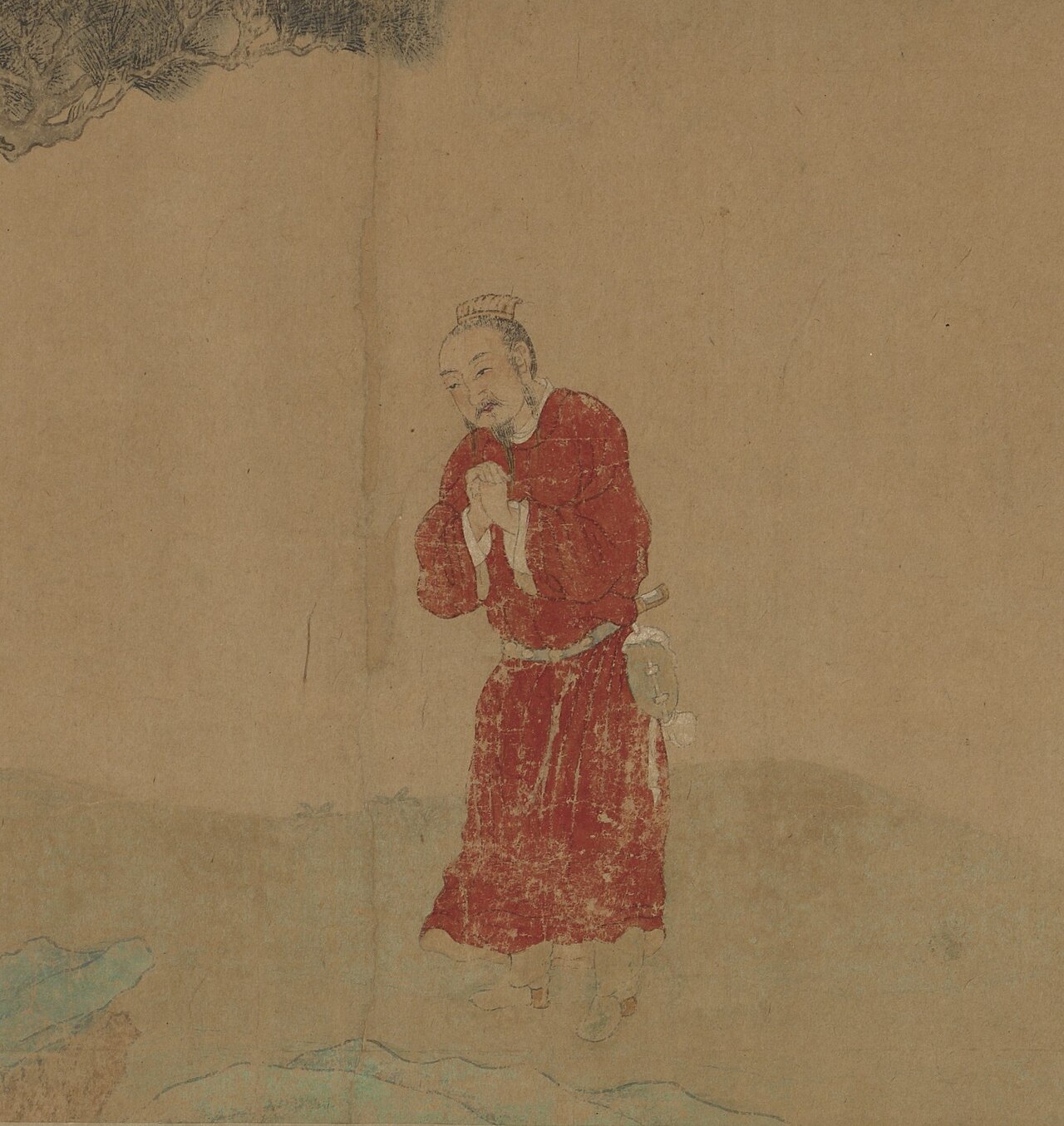
Shi Le as imagined by a Ming painter (detail from "Shi Le Worshipping the Buddha"). This is how later generations pictured him, not a portrait from life; he wears Han-style robes. Source: Wikimedia Commons, attributed to Qian Xuan, Freer Gallery of Art, CC0

Why Gu Yanwu looked back
I said this series would start in 1644, but the first piece has jumped to the fourth century. That needs explaining.
It isn't me going backwards; Gu Yanwu went first. He watched the Ming fall with his own eyes and wrote the Rizhilu (Record of Daily Learning), which has an entry called "Zhengshi." Zhengshi was a reign period of Cao Wei, 240 to 249 CE, when "pure conversation" (qingtan) came into fashion. Gu says the celebrated scholars of that time "abandoned the classics and favoured Laozi and Zhuangzi, spurned the rites and laws and prized abandon." Later "the Qiang and Rong took turns usurping, and rulers and ministers changed again and again," and "if not the worthies of the bamboo grove, whose fault was it?" That is: whom else can we blame?
His famous line, "there is the fall of a state, and there is the fall of all-under-Heaven," is written in that very entry. A man who had watched the Ming fall went looking for causes, and followed them all the way back fourteen hundred years.
So to talk about the fall of the Ming, we first have to look at the fall he was looking at.
Going beyond the moral order
Start with Ji Kang. In his essay On Dispelling Selfishness there is a very famous line: "Go beyond the moral order and follow nature." (The moral order here is mingjiao: the web of roles and duties, ruler and subject, father and son.) That is: I won't keep that mingjiao business, I'll follow my own heart.
It sounds dashing. But you have to know what mingjiao was at that time.
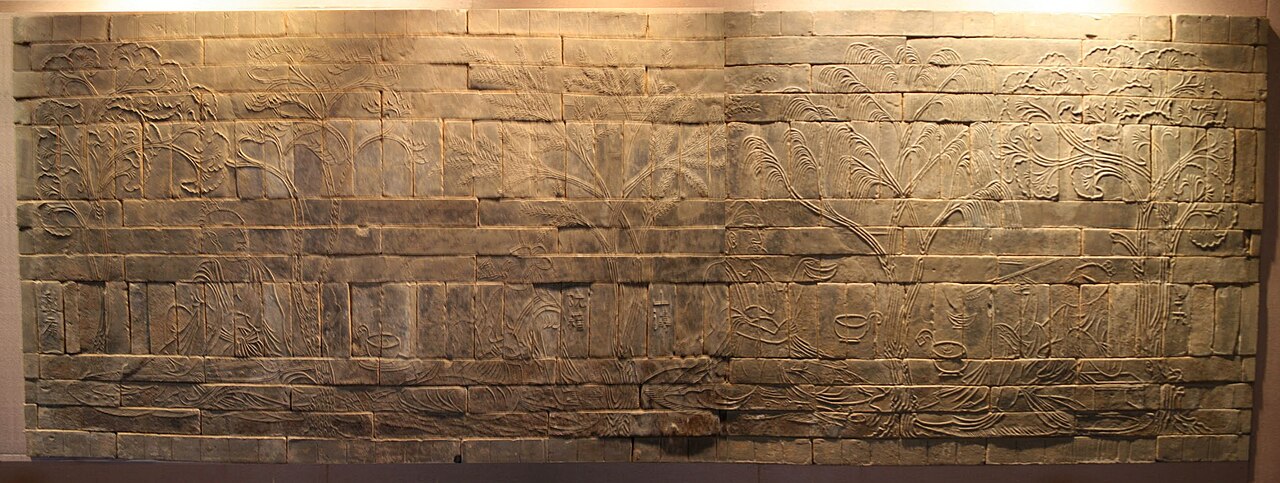
The moulded brick relief "Seven Sages of the Bamboo Grove and Rong Qiqi" found near Nanjing (Eastern Jin or Southern Dynasties). Ji Kang is one of the figures. Source: Wikimedia Commons, photo by Prof. Gary Lee Todd, CC BY-SA 4.0

Around 262, Ji Kang was killed by Sima Zhao. The man who spoke against him was Zhong Hui, who said Ji Kang and Lü An were "wild in speech and slandering the canonical texts," and advised: "Take this chance to remove them, to keep the customs pure." He was to be killed to make customs pure. On the day of the execution, three thousand students at the Imperial Academy petitioned to take him as their teacher; refused. Ji Kang looked at the shadow of the sun, asked for his zither, played one piece, Guangling San, and said this tune would die from today. He was around forty.
Lu Xun spoke about this in Guangzhou in 1927. His point was that those who professed the rites in Wei and Jin were in fact wrecking them, while those who seemed to wreck them "actually acknowledged the rites, believed in the rites too much." Cao Cao killed Kong Rong, the Simas killed Ji Kang, and in both cases the charge was something close to "unfilial": "But in truth, when had Cao Cao or Sima Yi ever been famously filial sons?" (Lu Xun writes Sima Yi here; the one who actually did it was his son Sima Zhao.)
Put plainly, by then mingjiao was already a knife. The mingjiao that Ji Kang went "beyond" was that one.
Neither the moral order nor pure conversation held
Look fifty years further on.
In 299, Jiang Tong wrote On Moving the Rong Away, urging the court to send the Di and Qiang who had moved inside the borders back out. The historians of the Book of Jin later called it "a far-sighted plan for governing the state," and a pity that it went unused.
In 304, Ji Kang's son Ji Shao stood in front of Emperor Hui of Jin at the Battle of Dangyin and was shot dead by stray arrows; his blood spattered the emperor's robes. Afterwards, when the attendants went to wash them, Emperor Hui said: "That is Attendant Ji's blood. Don't remove it." Ji Shao's father had been killed by the Sima family. Caught between his father's blood feud and the emperor's favour, he chose a road to death.
In 311, Luoyang fell. Wang Yan, the leader of pure conversation, was captured by Shi Le. He first said he had never concerned himself with worldly affairs since childhood, then urged Shi Le to take the imperial title. Even Shi Le could not stand it: "Wrecking the realm is precisely your crime." Before he died, Wang Yan said: if we had not prized the empty and the floating, and had all tried together to prop up the realm, it would not have come to this.
In the first month of 313, at Pingyang, the Xiongnu leader Liu Cong gave a great banquet for his officials and made the captured Emperor Huai of Jin put on a servant's blue robe and pour wine. An emperor, pouring wine cup after cup for his former subjects, and not long after, killed.
Mingjiao was a knife in the Sima family's hand; pure conversation was Wang Yan's signboard. By this point neither was any use.
So what was kept?
The Jin court moved south. Whenever the weather was fine, scholars who had crossed the river would invite each other to drink at Xinting outside Jiankang. Once, Zhou Yi sighed: "The scenery is no different, yet there is a difference in the mountains and rivers." The scenery was much like Luoyang, but the mountains and rivers were no longer those mountains and rivers. Everyone wept. Only Wang Dao's face changed: "We should be pooling our strength for the royal house and winning back the Divine Land. Why sit facing each other like Chu prisoners?"
At about the same time, Zu Ti led over a hundred refugee families across the river northward. In midstream he struck the oar and swore: "If Zu Ti cannot clear the Central Plains and cross this river again, may I be like this great river!"
My reading is this: in the one or two centuries of the "Five Barbarians' chaos in Hua," what the people who went south kept was not mingjiao. Mingjiao had already been worn out by the time of Ji Kang. What they kept was the Hua–Yi distinction.
By the Hua–Yi distinction I mean the difference of robes, caps and culture. It was never defined by blood. Shi Le's phrase "robed-and-capped Hua clans" is a ready-made footnote: even a Hu emperor recognised people by their robes. And later generations called this southward migration "the robes and caps crossing south" (yiguan nandu, "yiguan" being literally "robes and caps": the visible marks of being Huaxia).
A small detail. The "Chu prisoner" Wang Dao mentions comes from the Zuozhuan: Zhong Yi of Chu, captured and taken to Jin, kept wearing the Chu "southern cap," and a Jin minister praised him for "not forgetting his origins." Wang Dao used "Chu prisoner" to tell people not to weep, but the story itself is about a captive who kept wearing his own cap.
You can read the northern story from here too. A hundred and eighty years later, Emperor Xiaowen of Northern Wei ordered "a reform of the dress system," and the next year ruled that Xianbei could no longer be spoken at court, on pain of dismissal. A Xianbei emperor was changing the robes and caps of his own people.
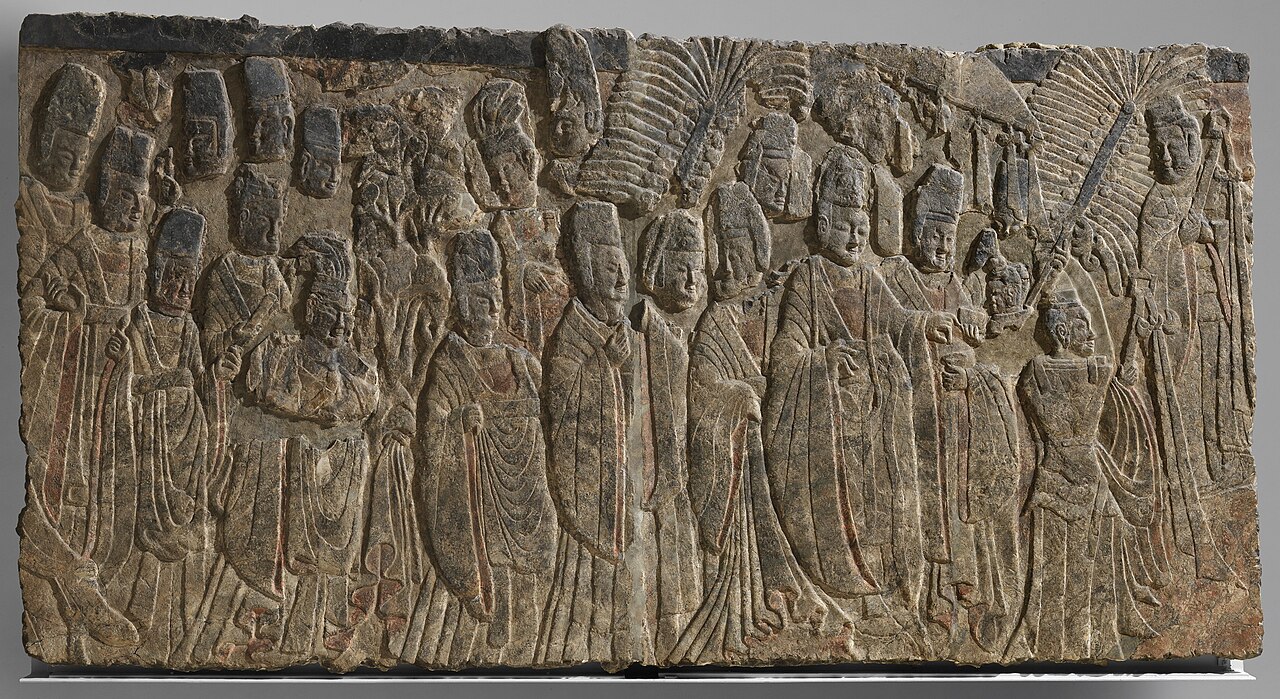
A section of the "Emperor and Empress Worshipping the Buddha" relief in the Central Binyang Cave at Longmen: Emperor Xiaowen and his party. Ruler and ministers wear wide-sleeved robes and tall caps; this is already Han court dress. Source: Wikimedia Commons, anonymous, CC0

Thirteen hundred years later
This line ran on for thirteen hundred years.
In the fifth month of 1644, the Qing army entered Beijing, and Dorgon ordered surrendering officials and people "all to shave their heads, and robes and caps to follow the dynasty's rules entirely." The next year, in the sixth month, he ordered again: "All must shave their heads. Whoever does not comply will be dealt with under military law."
This time the direction was reversed. Xiaowen had changed his own people's robes and caps; this order changed other people's. Shi Le had said no one may bully the "robed-and-capped Hua clans"; this order wanted a world in which there would be no more "robed-and-capped Hua clans."
After the order, robes and caps really did become a matter of life and death, and some people really did resist with them. The Ming official Zhang Chun was defeated in battle and held captive in the Sanguan Temple in Shenyang. According to the Korean Annals of the Joseon Dynasty, he kept on "wearing Han clothing" and "did not shave his head," and on the first day of each month "put on full robes and cap to bow in ceremony," always sitting facing west, toward Beijing. (Cited via Zhang Yuxing, "The Sanguan Temple in Shenyang and Early Qing History.") A man locked in a temple in a foreign land, once a month, dressing properly to bow to a capital he could not see. He died there; Hong Taiji "greatly regretted" it, had him buried with proper rites, and even built him a stone pagoda.
Gu Yanwu watched these two orders come down. In the "Zhengshi" entry he traces the fall of all-under-Heaven to the collapse of mingjiao, saying that pure conversation in Wei and Jin left the world "with no father and no ruler." He also scolded Ji Shao in particular: his father was killed by Sima Zhao, yet he went on to serve the Sima house, "forgetting his father and serving a ruler who was no ruler," and dying at Dangyin could not redeem it.
Now look at how, almost a hundred years later, the editors of the Qing's Complete Library of the Four Treasuries revised this entry. The passage scolding Ji Shao for having "no father," the half that speaks of mingjiao, they left untouched. "The Qiang and Rong took turns usurping" was changed to "armed conflict daily broke out"; and the whole stretch from "since the Zhengshi era" to "even the lowliest commoner has a share of responsibility" was deleted, including one line mocking the Western Jin scholars: "one after another they became subjects of Liu Cong and Shi Le, watching their former ruler pour wine in a servant's blue robe, and it did not move their hearts."
That is, the Qing court did not mind the lines about mingjiao; of the lines about Hua and Yi, not one word was kept. What Gu Yanwu himself spoke of was mingjiao, but the men who cut the book knew exactly which line stung.
We don't need to guess. In 1729, in the Record of Great Righteousness Dispelling Delusion, the Yongzheng emperor said it himself: "The whole Hua–Yi talk arose in the age of the Jin, Song and Six Dynasties, when the realm was divided," and called it "a most base and shallow view." In the same text he refers to his own dynasty as "we, outsiders." The Qing emperors knew better than anyone the difference between Manchu and Huaxia; they simply would not let others say it, much like Shi Le, who would not let anyone say "Hu."
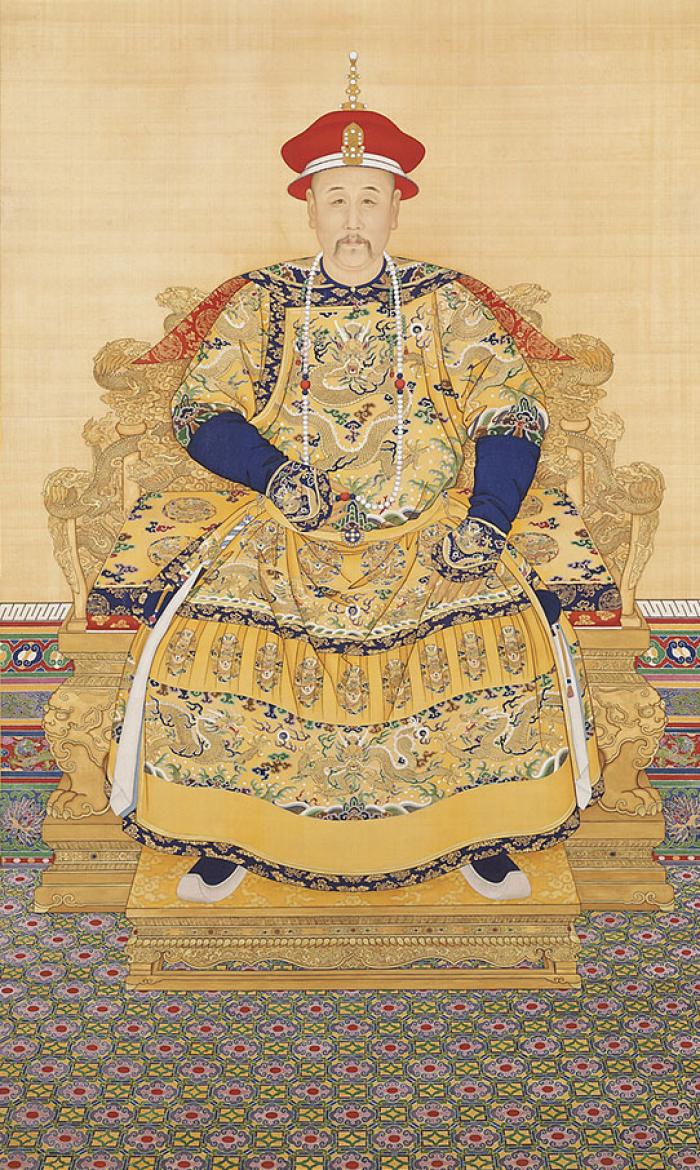
Portrait of the Yongzheng Emperor in court dress. Source: Wikimedia Commons, Qing court painter, public domain

The story of the book-cutting will come in the piece on Gu Yanwu. The next piece goes back to Beijing in 1644.
Let me say this more directly. Today a lot of people treat the Queue Order as "a custom changed," and pass over it lightly. I don't see it that way. Think: Shi Le forbade bullying the "robed-and-capped Hua clans," and Emperor Xiaowen changed his own people's robes and caps. These men were Hu, and not one of them said "we want the whole world to look like us." The 1645 order was blunt: not shaving means military law. Hair on the head became a line between life and death. In three hundred years, the most visible shell of a civilization was forcibly swapped. When I said in the preface that robes and caps were once Huaxia's yigui, and that after 1644 they were destroyed, this is what I meant.
I also don't want this to turn into "Manchus are bad." I'm talking about one order, one regime's act. The distinction matters. "Manchu" is a name the Yongzheng emperor himself used, and he said "we, outsiders," so I'll write it that way. The Queue Order was an act of the Qing state, so I'll write it as an act of the state, and not as the "character" of any people. Blood is not the cause; this series never uses blood as an argument, from beginning to end.
Looking the other way
First, Gu Yanwu himself is not on my side. His yardstick for "the fall of all-under-Heaven" is "benevolence and rightness choked off" and "no father, no ruler," plainly about mingjiao. The source I lean on most in this piece reaches the opposite conclusion from mine. My reading is: he spoke of mingjiao, and the men who cut the book read Hua–Yi. But in the end that's a reading.
Second, the Six Dynasties gentry actually lived off mingjiao. Huang Rucheng's Collected Commentaries on the Rizhilu attaches to the "Zhengshi" entry a remark by a Compiler Yang, saying that although the Six Dynasties' atmosphere was frivolous, it had a few things later ages could not match: valuing family taboos, valuing lineage, being careful about marriages, distinguishing ranks, and upholding public opinion. By that account, what the southward gentry kept was precisely family ritual and mingjiao, and the Hua–Yi distinction was only one side of it.
Third, and the hardest to answer: if the Hua–Yi distinction looks only at robes and culture and not at blood, then when a Hu adopts Hua robes and caps, is he Hua? In 304 Liu Yuan raised his banner and named his state "Han," posthumously honouring Liu Chan, saying: "Do emperors have a fixed pedigree? Yu the Great came from the western Rong, King Wen was born among the eastern Yi; it depends only on whom virtue is given to." Fourteen hundred years later, the Yongzheng emperor said: "That our dynasty is Manchu is like China's having native places. Shun was a man of the eastern Yi, King Wen of the western Yi." Nearly the same argument. If you draw Hua and Yi by culture, the door is open, and the people walking through will use that principle to speak for themselves.
My answer to this one: you have to look at direction. Xiaowen was a Hu moving toward Huaxia's robes and caps himself: he changed Xianbei dress for Han court dress and even regulated what language was spoken at court. That was strict even on his own people, but the direction was inward, through the door. The 1645 order was the reverse: it asked the people already inside to move outward and take on someone else's appearance. Both look like "robes and caps changed," and the directions are opposite. I think this standard holds: those who are willing to come in are welcome, and once in, they are our own; ancestry doesn't matter. Forcing people inside the door to change is not a cultural question any more, it is a question of power. As for Yongzheng's "Shun was a man of the eastern Yi," it's a fine speech; but the Qing, while saying "come in and you are Chinese," carried on with the old rule of "no queue, no head." Put those two things side by side and you can see the speech was a tool.
Fourth, people at the time did not draw the line so cleanly themselves. Jiang Tong's On Moving the Rong Away says the Rong and Di have "speech that doesn't communicate, gifts that differ, laws and customs that are strange, kinds that are different," and mixes language, custom and descent together. "The Hua–Yi distinction looks only at robes and culture" is one way of reading it; the ancients did not always use it that way.
There is another end of this yardstick I haven't finished: the neighbours. After 1644, Joseon Korea refused to recognise the Qing as Zhonghua and called itself "Little China," and what it used was exactly robes and rites: we still wear Ming clothes, we still perform Ming rites. I leave that end for The Neighbours' Heaven. I mention it here only to make one point: the yardstick of robes and caps is not something I took out on my own; for centuries, those on Huaxia's edges who read Chinese books most seriously have used it.
Last, how this piece relates to Duoshe. Duoshe tells many stories of "changed the god, kept the language" or "conquered, and then rewrote the conquerors." That is looking sideways. Shi Le, Emperor Xiaowen and Gu Yanwu are looking down the depth at the same kind of thing. What a civilization ends up keeping depends on which things people are living every day.
If you could keep only one, the moral order or the robes and caps, which do you think the people who went south actually kept?
References
- Ji Kang, On Dispelling Selfishness, in Collected Works of Ji Kang
- Book of Jin: juan 5 "Annals of Emperor Xiaohuai"; juan 43 "Biography of Wang Yan"; juan 49 "Biography of Ji Kang"; juan 56 "Biography of Jiang Tong" (with On Moving the Rong Away); juan 62 "Biography of Zu Ti"; juan 65 "Biography of Wang Dao"; juan 89 "Biographies of the Loyal and Righteous: Ji Shao"; juan 101 "Account of Liu Yuanhai"; juan 105 "Account of Shi Le, part two"
- Liu Yiqing, A New Account of the Tales of the World, "Speech and Conversation," with Liu Xiaobiao's commentary
- Book of Wei, juan 7B, "Annals of Emperor Gaozu, part two"
- Gu Yanwu, Rizhilu, entry "Zhengshi" (Huang Rucheng's collected commentary edition, juan 17; Complete Library of the Four Treasuries edition, juan 13)
- Veritable Records of Emperor Shizu, juan 5 and 17 (cited via Zhang Chang, "A Reconsideration of the Qing Hair-Shaving Policy — in Dialogue with Mr. Yu Hongliang," Journal of Tsinghua University (Philosophy and Social Sciences) 2021, no. 3)
- Yongzheng, Record of Great Righteousness Dispelling Delusion, juan 1, 1729
- Lu Xun, "Wei–Jin Manners, Literature, Medicine and Wine," 1927, in And That's All (Er Yi Ji)
- Zhang Yuxing, "The Sanguan Temple in Shenyang and Early Qing History" (the Zhang Chun section, cited; original from Wu Han, ed., Chinese Historical Materials in the Annals of the Joseon Dynasty, vol. 9)
- Wang Yuanchong, an article in The Paper (Joseon held rites for the Ming at the Daebodan altar in Hanseong from 1704 to 1897; "Little China" consciousness); Ge Zhaoguang's work on "Great Ming robes and caps" in the Yanxing (Beijing travel) literature (🟡, both second-hand)
- Image sources are given in each caption