A New Testament printed in Singapore in 1839
In 1839 the Chien-Hsia (Jianxia) Academy in Singapore printed a New Testament called Jiushizhu Yesu xin yizhao shu, "The New Testament of Jesus the Saviour." Its translator was the Prussian missionary Karl Gützlaff, the same man who, in the previous piece, wrote "Shangdi" into the Bible.
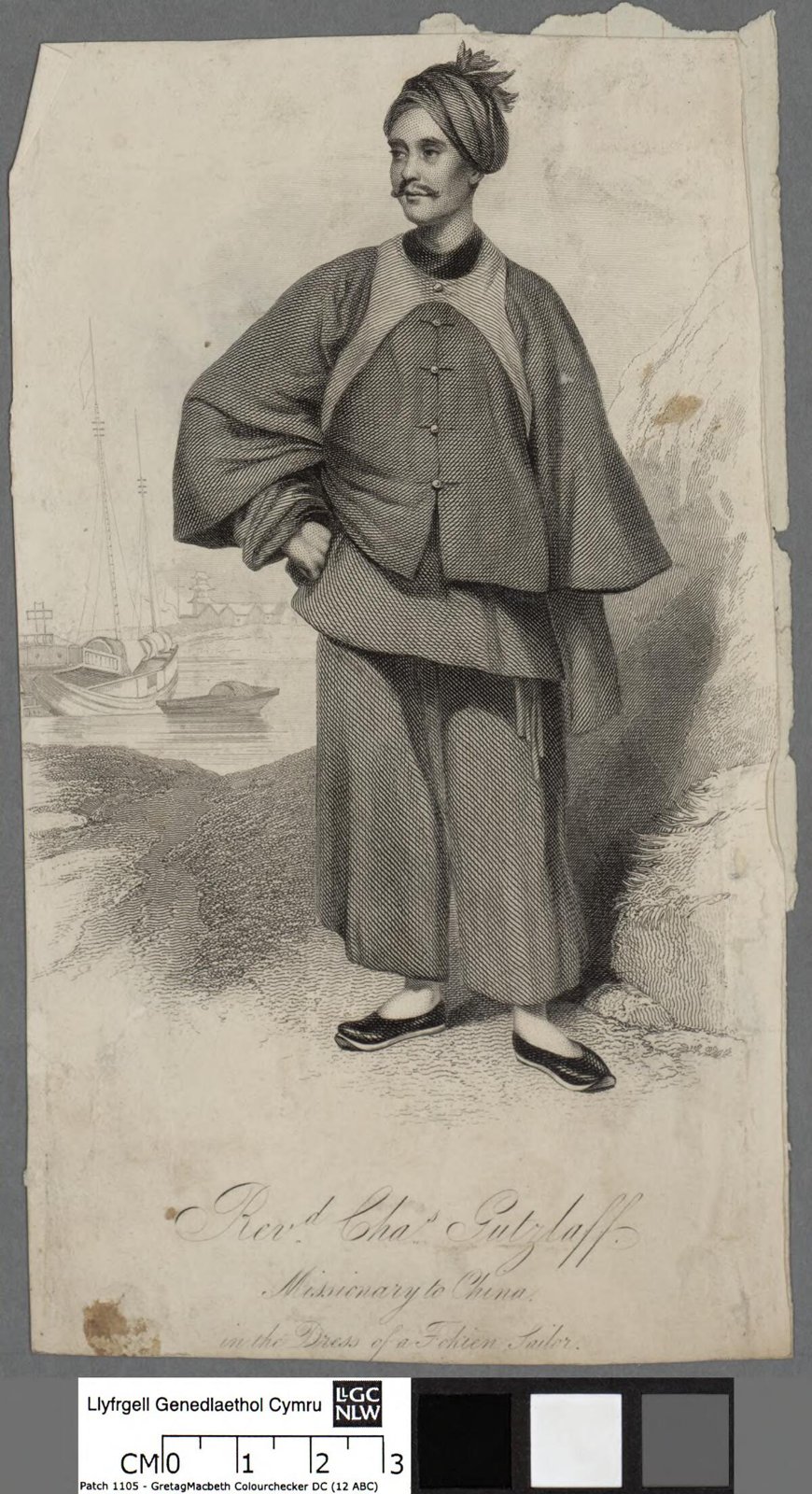
Karl Gützlaff (1803–1851), Prussian missionary. Source: Wikimedia Commons, National Library of Wales, public domain

In the seventh chapter of this book's Epistle to the Hebrews, the first three verses read:
"昔亚伯拉罕败列王而凯旋,遇撒冷之王,至上帝之祭司,麦基洗德,蒙其祝福。" (In the old days Abraham defeated the kings and returned in triumph, and met the king of Salem, priest of the Shangdi, Melchizedek, and received his blessing.)
"夫麦基洗德译名本乃义王,又撒冷之王,即平王。" (Melchizedek, by translation of his name, is the king of righteousness, and also the king of Salem, that is, the king of peace.)
"其无父,无母,亦无族谱,无始日,无终生,成如上帝之子,永为祭司也。" (He had no father, no mother, no genealogy, no beginning of days, no end of life; made like the son of Shangdi, he remains a priest forever.)
Eight years later, an edition of this book reached Hong Xiuquan.
A man nobody in the Bible can explain
Melchizedek appears very little in the Bible.
In Genesis, Abraham defeats several kings, and on his way back Melchizedek, king of Salem, comes out with bread and wine to meet him and bless him. Abraham gives him a tenth of what he has taken. Then this man never appears again.
More than a thousand years later, the author of the Epistle to the Hebrews brings him up once more and says the sentence people have turned over for two thousand years: he has no father, no mother, no genealogy, no beginning of days and no end of life, and like the Son of God he is a priest forever.
So who is he? Some say an angel; some say Christ appearing once in the Old Testament; some say just an ordinary petty Canaanite king. Explanation after explanation, and none has satisfied everyone.
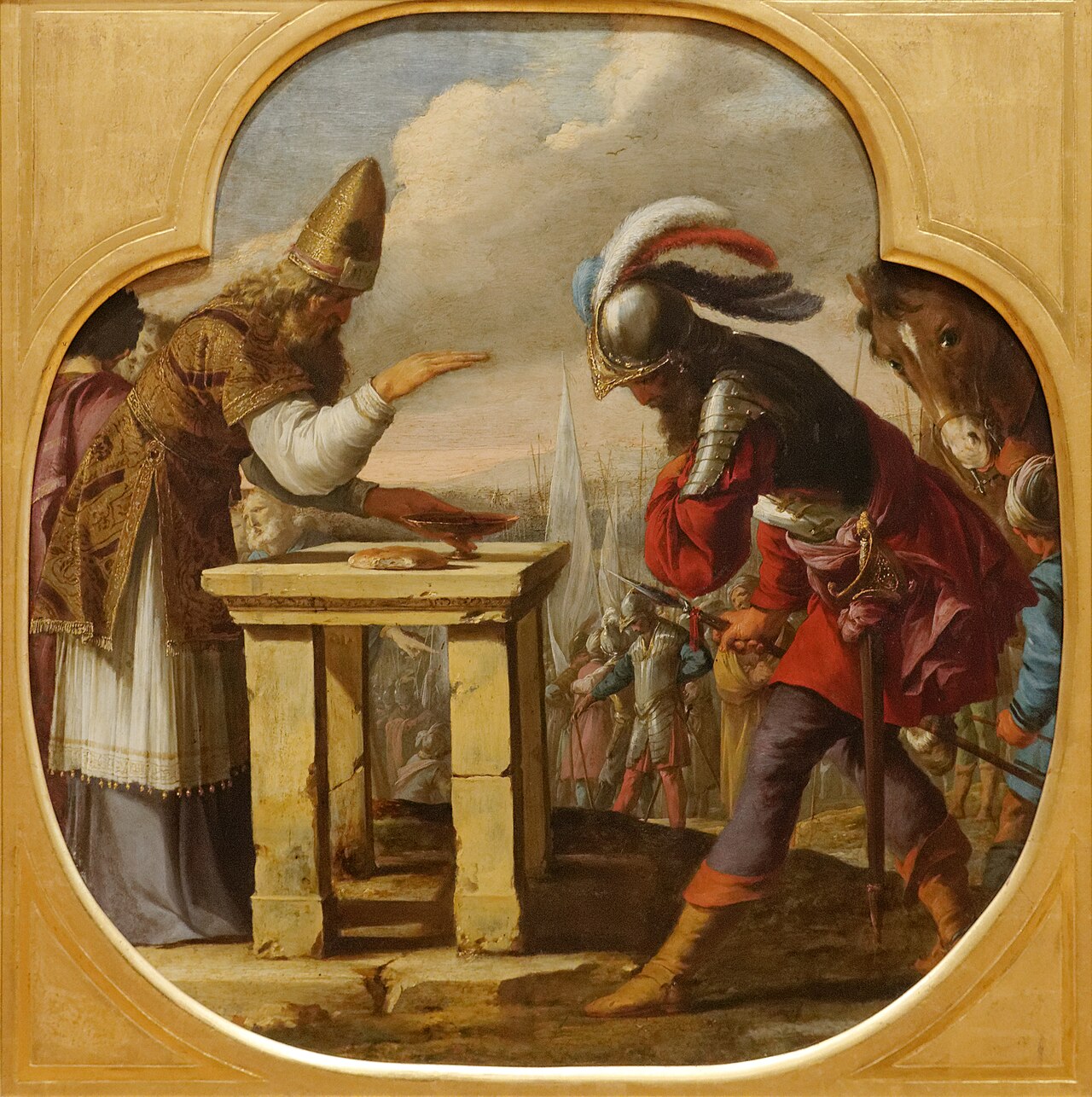
"Abraham Meets Melchizedek" by the French painter Laurent de La Hyre. The figure coming forward with bread and wine is Melchizedek, king of Salem. Source: Wikimedia Commons, Laurent de La Hyre, public domain

This is an acknowledged empty seat in the Bible.
Hong Xiuquan wrote a line beside it
Hong Xiuquan's reading was direct.
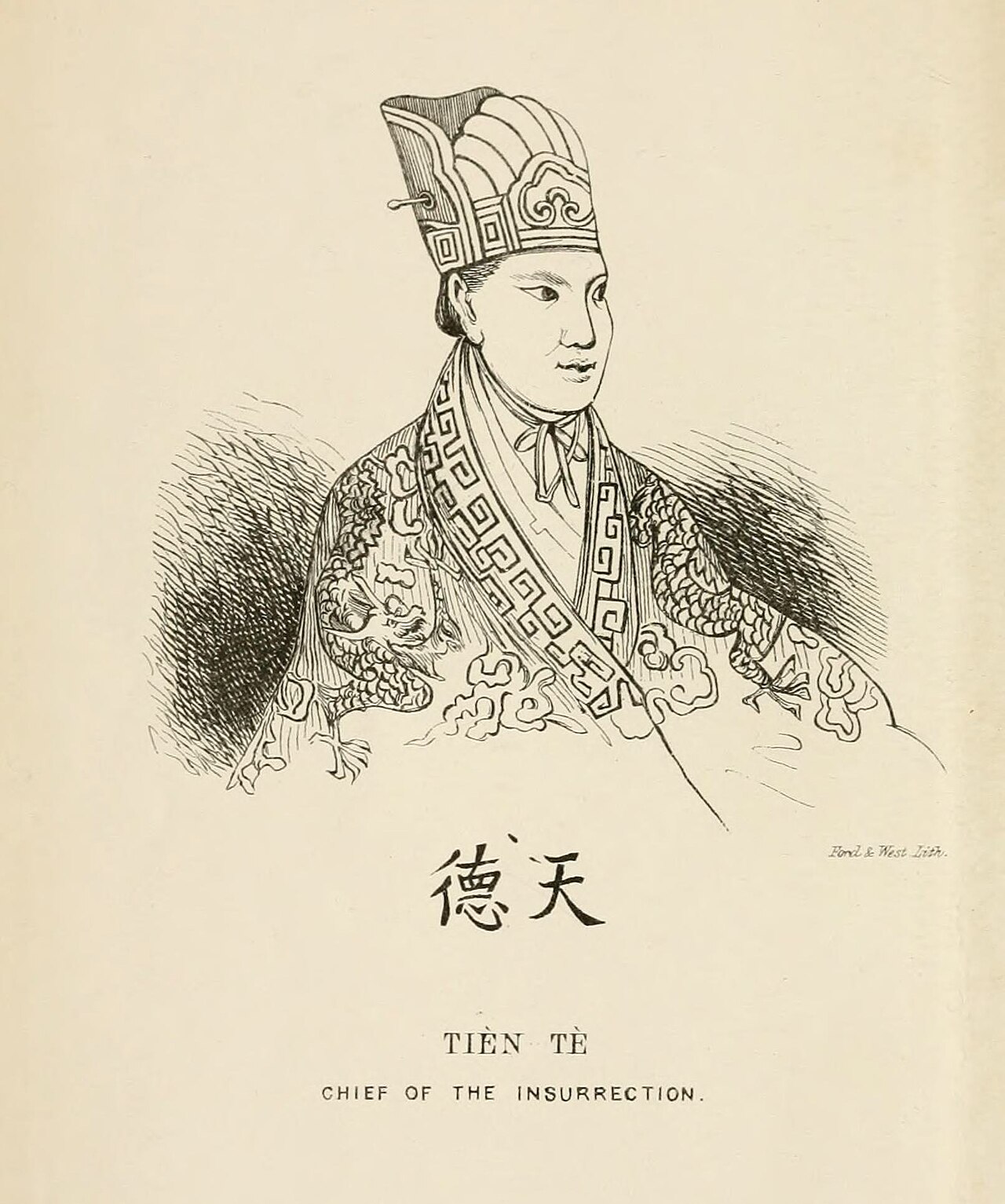
A portrait of Hong Xiuquan printed in a European book; the caption says it is "said to be" him, and its authenticity is doubtful. Source: Wikimedia Commons, lithograph by Ford & West, public domain

According to the scholar Archie Lee (Li Chichang), Hong Xiuquan later added marginal comments to the Bibles printed by the Taiping Heavenly Kingdom. At the Genesis passage where Melchizedek blesses Abraham, he wrote that Melchizedek was "that is me (zhen)." He meant that he had himself once come down from Heaven and shown this "trace," which now served as proof that he was descending to rule as king today.
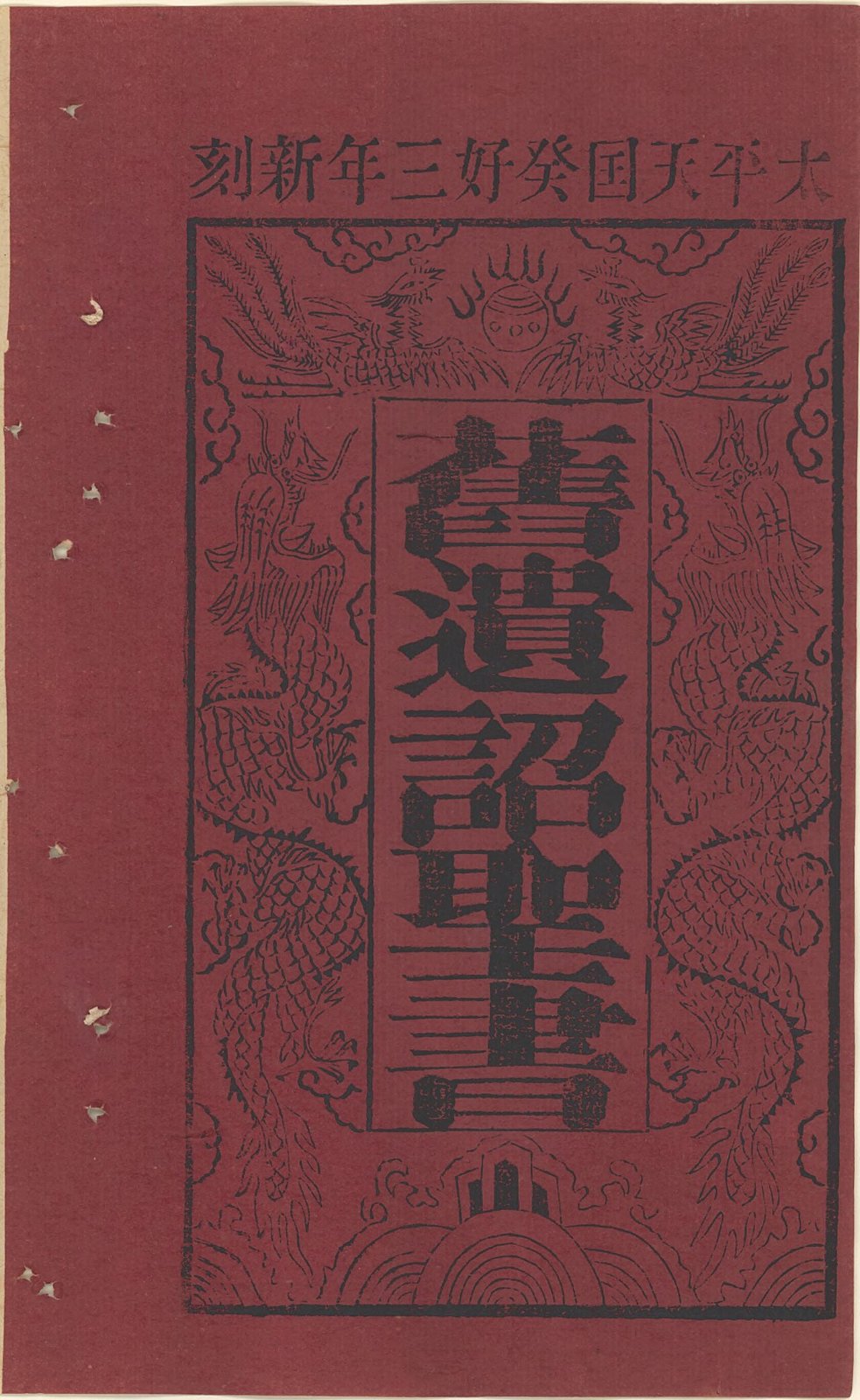
Cover of the Jiuyizhao shengshu (Old Testament) published by the Taiping Heavenly Kingdom, bearing "newly cut in the third year of the Taiping Heavenly Kingdom, Guihao." Hong Xiuquan's marginal comments were written in reprinted editions of this kind. Source: Wikimedia Commons, anonymous, public domain

Think about it: a man with no father, no mother, no genealogy, no origin could appear in any age and make sense.
Reading this, something in me aches. Hong Xiuquan was a poor scholar who had failed the examinations four times. In that time a person's birth, genealogy and examination rank were his whole "origin," and he had none of them. And in a book translated by foreigners he found a man who needed none of these and could still be a priest and a king.
One more line is worth a second look. Gützlaff's translation says "king of Salem, that is, the king of peace (ping wang)." Salem means peace. What Hong Xiuquan thought when he read the two characters "king of peace," I do not know. I only know that the state he later built was called the Heavenly Kingdom of Great Peace (Taiping).
He used their own book
What is uncomfortable here is not that Hong Xiuquan was bold. It is his method.
"No father, no mother, no genealogy" was the missionary's own translation, and "the Son of Shangdi" was the missionaries' own choice of words. Hong Xiuquan invented not one character. He took the text they handed him and read it literally.
And reading scripture literally was exactly what Protestant missionaries taught Chinese believers. They opposed the Catholic Church holding the right of interpretation and argued that everyone can read scripture for themselves. Hong Xiuquan did just that, and in the course of reading sat down in this empty seat.
Afterwards the missionaries disowned him, and Catholics and Protestants alike judged his doctrine heresy. But to refute him they first had to explain one thing: why you may read the same book that way and he may not read it this way.
Turning it around
Orthodox theology does have an answer. It is called "typology."
On this reading, Melchizedek is not a supernatural being but a "type" of Christ, an Old Testament figure who sketches in advance what Christ would be. "No father, no mother, no genealogy" means that the text records no genealogy for him. In Israel a priest had to come from the tribe of Levi with a traceable lineage; Melchizedek is a priest without relying on genealogy, and the author of Hebrews builds his argument precisely on this "gap in the record." "Made like the Son of God" is a comparison, not an identity.
Following that line, one can also ask Hong Xiuquan: if Melchizedek really had no beginning and no end, how does he come out of the city in Genesis with bread and wine and accept a tenth from Abraham? He has a body, a city-state, and lives on one particular day. The verse you use was written by someone whose argument runs exactly opposite to yours.
There is another point that may matter more. Hong Xiuquan's "heavenly family" first appears in a strange dream of 1837, which the Taiping tianri, written in 1848, records. His marginal comments in the Bible came only in 1860, when the Taiping reprinted the Bible.
That is to say: dream first, scripture later. The scripture was not the source of his vision; it was what he later used to confirm it. So perhaps it was not an empty seat that waited for him; he had the seat first, and then went to the book to find an empty place.
By the way
A line of Hong Xiuquan's annotation circulates online: "Melchizedek is truly me" (six characters in Chinese).
I could not find a first-hand source for it. Two versions can be traced to scholarly literature, one written beside Genesis and one beside Hebrews, with different wording. The six-character slogan is probably a later summary that, passed along, came to be treated as the original words.
A story about "the man without a genealogy" has itself acquired a stretch of retelling whose origin cannot be traced. There is something fitting in that.
I tell this story as a warning. A scripture may leave an empty seat; that is not forbidden. But once someone feels he can sit in it and say "that is me," what follows is out of anyone's hands. After Hong Xiuquan sat down, his own words became the highest words; Yang Xiuqing, speaking through the Heavenly Father, could override the Heavenly King; and in the end even the Old and New Testaments "have many errors and the errors must be corrected." Countless people were swept in.
So when I imagine the thing I want, I deliberately leave this seat empty. What I have in mind is this: Heaven's Way (Tiandao) is a supreme divinity that does not speak, does not descend, does not possess anyone, does not hand a decree to anyone; it is to be revered, not petitioned. Confucius is the First Teacher, the one who collected and handed down, not one who received a revelation; he never said "this is what Heaven told me directly." With both ends sealed, no one can stand up and say "I am the one." I don't think this guarantees safety, but at least no one will take a verse of scripture and lead a country in.
If a book leaves an empty seat, who is entitled to sit in it?
References
- Jiushizhu Yesu xin yizhao shu (New Testament), translated by Karl Gützlaff, printed in 1839 at the Chien-Hsia Academy, Singapore (Taiwan's "Faith, Hope and Love" rare Bible digital collection; the copy held by the National Library of Australia)
- Morrison and Milne translation, Hebrews 7:3 (same system, for comparison)
- Archie C. C. Lee, "The Bible in China: Taiping Interpretation of Scripture," Journal of Shenzhen University (Humanities & Social Sciences), 2009, no. 6
- Zhao Xiaoyang, "On the Source Texts of the Bibles Printed by the Taiping Heavenly Kingdom," Qing History Studies, 2010, no. 3
- Taiping tianri, 1848
- Genesis 14; Hebrews 7
- Image credits are in each caption