A question from the internet
There is a question asked online again and again: why does Zhuangzi rank so low in Daoism?
One netizen set out four classical passages: Xunzi says Zhuangzi "is blinded by Heaven and does not know man"; in the "Tianxia" chapter of the Zhuangzi, Zhuangzi and Laozi are written separately; Wang Xizhi, in the Orchid Pavilion Preface, scolds "making life and death one, equating the long-lived and the short-lived" as empty and false; and Ge Hong, in the Baopuzi, criticizes Zhuangzi.
If all four are real, this is not just a matter of "low rank." Along the road, several weighty groups of people were all against Zhuangzi.
First, what does "low" mean?
But first the word "low" needs a question.
In the first year of Tianbao under Emperor Xuanzong of Tang (742), the court posthumously honored Zhuangzi as the "True Man of Nanhua," and his book was renamed the True Scripture of Nanhua. Wenzi (True Man of Tongxuan), Liezi (True Man of Chongxu) and Gengsangzi (True Man of Dongxu) were honored at the same time. This is according to the Old Book of Tang and the Tang huiyao; I read it at second hand and did not read the originals.
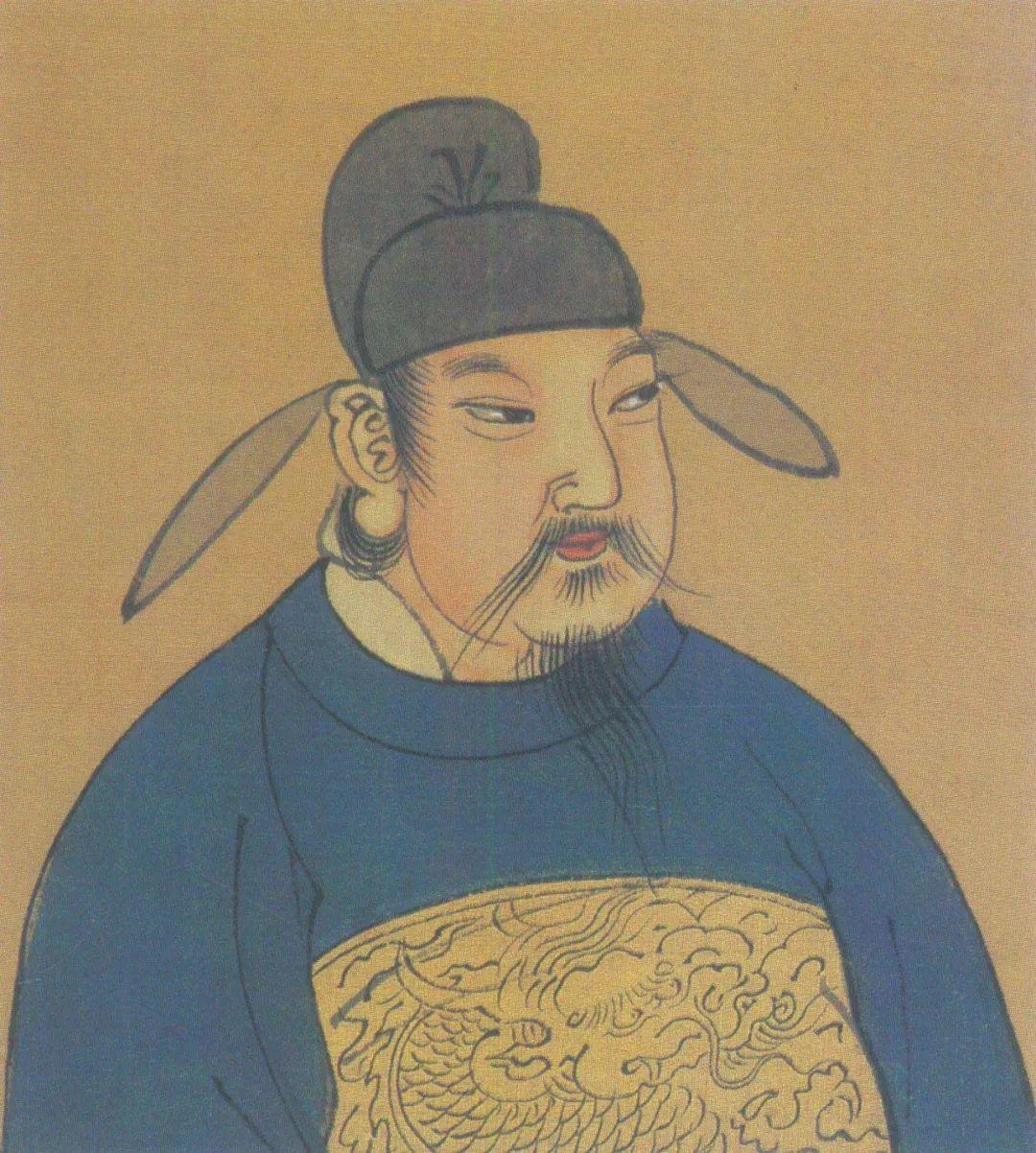
Portrait of Emperor Xuanzong of Tang, Li Longji, painted in the Ming. Source: Wikimedia Commons, anonymous, public domain

So officially he was not looked down on. He had a title.
Then "low" compared with whom? With Laozi. Daoism reveres Laozi as the Supreme Lord Lao (Taishang Laojun), a god within the religion, and the Li imperial house of Tang even claimed Laozi as an ancestor. Zhuangzi is a "true man," in the rank behind, among the disciples of this great god. The religion honors him, but he is not its founder.
That is one way to see "rank." The other, below, matters more.
Four passages
First, Xunzi. In "Dispelling Blindness" in the Xunzi, Xunzi goes down the schools of the Warring States one by one:
Mozi was blinded by utility and did not know refinement. Songzi was blinded by desire and did not know attainment. Shen Dao was blinded by law and did not know worth. Shen Buhai was blinded by position and did not know knowledge. Huizi was blinded by words and did not know reality. Zhuangzi was blinded by Heaven and did not know man. (my translation)
Note that this is not abuse aimed at Zhuangzi alone; it is a list. Each school is "blinded" at one end: Mozi sees only use, Shen Dao only law, Shen Buhai only power, Huizi only words, Zhuangzi only Heaven. Xunzi's point is that all these are "one corner" of the Way: "the Way embodies the constant and exhausts all change; one corner is not enough to hold it up."
So what Xunzi criticizes in Zhuangzi is "seeing only Heaven, not man."
Second, the "Tianxia" chapter of the Zhuangzi. This is the last chapter, a general review of the schools of the day. It puts Guan Yin and Lao Dan together in one passage:
Guan Yin and Lao Dan, ah, the broad and great True Men of old! (my translation)
Then it gives Zhuang Zhou a separate passage, opening with the same phrase:
The arts of the Way of old that lie in this: Zhuang Zhou heard of their ways and delighted in them. (my translation)
Both passages use "heard of their ways and delighted in them." That is, in the way "Tianxia" is written, Guan Yin and Lao Dan are one line and Zhuang Zhou another, each "hearing the wind and delighting" in a different side of the ancient art of the Way. This is the basis for the netizen's remark that "Zhuangzi and Laozi are not the same line." But it is only one reading: whether the "Tianxia" chapter was written by Zhuangzi himself is disputed among scholars, and treating it as "Zhuangzi's own account" goes too far.
Third, Wang Xizhi. In 353, the ninth year of Yonghe, Wang Xizhi gathered with friends at the Orchid Pavilion in Kuaiji and wrote the Orchid Pavilion Preface. Near its end he wrote:
The ancients said: "Life and death are great matters." How painful! Each time I read why people of old were moved, it is like matching two halves of a tally; I never fail to sigh and grieve over the text, and cannot put it into words in my heart. I know that making life and death one is empty talk, and that equating the long-lived and the short-lived is reckless invention. (my translation)
"Making life and death one" and "equating the long-lived and the short-lived" are Zhuangzi's words. Wang Xizhi says: when I read of others' grief before death, each time I cannot help being sad. So I know that treating life and death as one thing, and a long life and an early death as the same, is empty talk, reckless invention.
Fourth, Ge Hong. Ge Hong was a Daoist scholar of the Eastern Jin who wrote the Baopuzi, on immortals and nurturing life. He speaks of Zhuangzi in three places, with quite different intent.
In the Inner Chapters, scroll 8, he puts Wenzi, Zhuangzi and Guan Yin's followers together and says that though their writings "take Huang-Lao as their ancestors and the dark and void as their model," "when you draw out their main points, there are no ultimate words," and "some even equate life and death, saying that to be alive is no different from forced labor and to die is rest; from the immortals they are a hundred billion li away; are they worth lingering over?" Yet right after, he says their fables and parables "still have something to pick up."
In the Inner Chapters, scroll 14, he is blunter: "Common people see Zhuang Zhou's parable of the great dream and vie to spread the theory of equating life and death. ... Laozi made long life his business, while Zhuang Zhou prized wagging his tail in the mud, refusing to be a tortoise caught in a net or an ox draped in embroidery, and when hungry begged grain from the River Lord; from this we know he could not equate life and death." The meaning: Zhuang Zhou himself would rather be a tortoise wagging its tail in the mud than a sacrificial ox honored; when hungry he went to borrow grain. So he did not really regard life and death as one.
In the Outer Chapters, scroll 43, he speaks up for Zhuangzi: "Zhuang Zhou's book takes life and death as one, yet he also feared the sacrificial ox, admired the tortoise, and begged grain to relieve hunger. To throw away his writing because what he says is not pure is like curing a cataract by gouging out the eye, treating damp-rheumatism by cutting off the foot, worrying about weeds by cutting down the grain, or hating a dead branch and felling the tree." Do not throw away the whole book because he is not consistent.
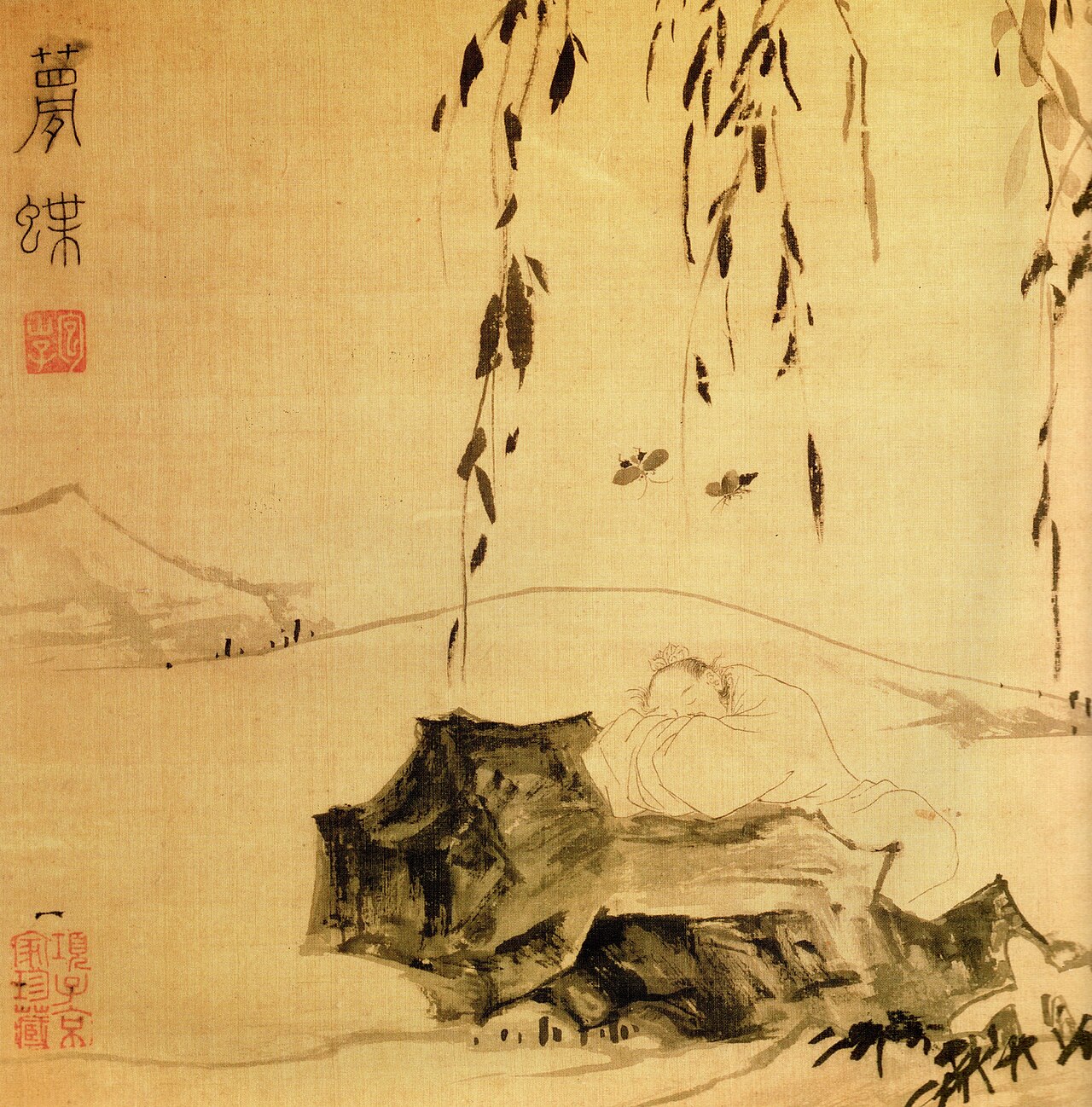
Lu Zhi, "Zhuang Zhou Dreams of a Butterfly" (Ming dynasty). Source: Wikimedia Commons, Lu Zhi, public domain

Three people, one question
Put the three passages side by side and one thing stands out:
Xunzi is a Confucian and wants ritual, human affairs. Wang Xizhi is a gentleman scholar and wants feeling for the dead. Ge Hong is a Daoist seeker of immortality and wants long life. They stand in very different places, but all three are against "equating life and death."
This is no coincidence. Each of these communities, Confucian, scholarly, immortality-seeking, has one thing it must answer: when a person dies, what then?
The Confucian answer is funeral rites and ancestor worship: be careful at the end, remember the distant past. Wang Xizhi's answer is "pain": he wants to grieve in earnest. The immortality-seekers' answer is: find a way not to die, or to die less.
And what is Zhuangzi's answer? There is a famous passage in the "Perfect Happiness" chapter:
When Zhuangzi's wife died, Huizi went to offer condolences, and found Zhuangzi squatting with legs spread, drumming on a basin and singing. (my translation)
Huizi found it outrageous. Zhuangzi said: when she had just died, how could I not grieve? But I thought it over: originally she had no life, no form, no breath; later breath gathered into form, form became life, and now it has become death again, like spring, summer, autumn and winter going round. If I were still sobbing there, I would show I don't understand fate, so I stopped crying.
Reading this, I find it moving, and also lonely. It is one person's way of coping when the person closest to him dies. It can console one person, but cannot hold a funeral for a crowd.
To hold a funeral you need a ritual everyone recognizes: what to weep, what to wear, what to say, how many days, how to bury. Zhuangzi's way each person has to realize alone; if they cannot, it cannot be received.
So my reading is: Zhuangzi was not "demoted"; he was not usable. A religion that means to hold a group of people together must have at its core an answer to death and a shared ritual. Zhuangzi cannot give that. What he gives is freedom.
Turning it around
I'll pick some faults in my own account.
First, "low" is only inside the religion. Among scholars, writers and artists, Zhuangzi's weight has never been low: Wei-Jin "dark learning," the tradition of free roaming, generation after generation of painters and poets. Lu Zhi's Zhuang Zhou Dreams of a Butterfly was painted by a Ming man. In the "religion" he is put in the second row; in the spirit of "people" he is often first.
Second, Ge Hong is only one man. He represents the immortality-seekers, not the whole of Daoism. He also said "fables and parables still have something to pick up," and defended Zhuangzi in the Outer Chapters. How Daoism after the Song, such as Quanzhen, read Zhuangzi, I have not checked. That is a gap.
Third, whether "equating life and death" is really Zhuangzi's own meaning is also disputed. Ge Hong himself says Zhuang Zhou "prized wagging his tail in the mud," that is, he was afraid of dying. If so, what Zhuangzi wanted may not be "death is not worth grieving" but "don't let death frighten the soul out of you." The two are far apart.
What I think
These passages give my plan a very concrete reminder.
What I want is a body of culture and belief that everyone recognizes: ancestor veneration, ritual, dress, festivals, everyday life. The core of this is an answer to death: every Qingming, standing before the ancestors' graves, that moment is a person and a whole family together turning death into something that can be "passed through." This is Confucian funeral rite and ancestor worship, a thousand years old, and it is what I want to keep.
I also like Zhuangzi very much, and Laozi's "in pursuing the Way, lose a little each day." For one person, tired, to read now and then, it is good. But what I want is not one person's comfort but something a group can do together. So in the core I imagine, Zhuangzi would be a reader, not a ritual.
Zhuangzi's "drumming on the basin and singing" also makes my heart ache a little. That man, before his wife's coffin, alone, worked out one thing. I am willing to believe he wept. But we cannot take "one person working it out" as the answer to "what do we all do together."
Could a society with only Zhuangzi hold a funeral?
References
- Xunzi, "Dispelling Blindness": "Mozi was blinded by utility... Zhuangzi was blinded by Heaven and did not know man.... The Way embodies the constant and exhausts all change; one corner is not enough to hold it up," Wikisource, checked word for word 🟢
- Zhuangzi, "Tianxia": "Guan Yin and Lao Dan, ah, the broad and great True Men of old" and "Zhuang Zhou heard of their ways and delighted in them," Wikisource, checked word for word 🟢; authorship and nature of "Tianxia": disputed among scholars 🟡
- Zhuangzi, "Perfect Happiness": "When Zhuangzi's wife died, Huizi went to offer condolences, and found Zhuangzi squatting with legs spread, drumming on a basin and singing," via Wikisource Zhuangzi yi, scroll 5, search excerpt 🟡 (editions vary)
- Wang Xizhi, Orchid Pavilion Preface (353), Wikisource, checked word for word 🟢
- Ge Hong, Baopuzi, Inner Chapters scrolls 8 and 14, Outer Chapters scroll 43 (also, in Outer Chapters scroll 42, a guest's question: "Boyang puts the Way and Virtue first, Zhuang Zhou puts 'Free and Easy Wandering' at the head of his book"), Wikisource, checked word for word 🟢
- Emperor Xuanzong of Tang's posthumous title for Zhuangzi, "True Man of Nanhua," in the first year of Tianbao (742): Old Book of Tang, annals of Xuanzong, and Tang huiyao, via online retellings 🟡; Daoism's reverence of Laozi as Supreme Lord Lao: common account 🟡
- Online discussion on the topic (netizens' views, a lead only)
- For comparison: in Yigui, the piece on "resting in peace in the earth," and "Where Religions Win: Not in Doctrine but in a Pot of Food"; the author's topic notes (what is missing is "the afterlife": the hole Buddhism filled)
- Image credits are in each caption