A question from the internet
Someone asked online: some people say that under the Jurchen-ruled Jin the Han lived better than under the Song. Do you believe it?
One top-ranked answer got a lot of agreement. The poster began with a woman from Shandong, Yang Miaozhen, who wielded the "pear-blossom spear," and who is mentioned by Qi Jiguang in his Jixiao xinshu. Then a scene: around 1220, on the roads of Shandong and northern Jiangsu, Jurchen and Khitan families who had been wealthy under the Jin, dragging their households south, were surrounded by Red Coat troops and killed, "old and young alike, to the last." Yuan Haowen saw this with his own eyes, the poster said, and that is why he wrote "slaughtered to the last, not a single mouth left."
The reply amounts to: you say the Han lived well under the Jin? Look at what the Han did when they rose up.
Half of this is true. The other half needs checking.
First, the "lived well" side
This claim did not come from nowhere.
In the History of the Jin, Emperor Shizong (r. 1161–1189) is much praised. The historians appended a comment to his annals:
Five years after he took the throne, north and south made peace and the people were left to rest. ... In those days the officials kept to their posts, high and low lived in harmony, every household had enough and the granaries had surplus. The Board of Punishments sentenced to death in a year perhaps seventeen, perhaps twenty, and he was called "Little Yao and Shun." That was the proof. (my translation)
"Seventeen or twenty death sentences in a year" is a vivid line. But note: this is a historians' eulogy, and the History of the Jin was compiled under the Yuan. The ones saying kind things were looking back decades later.
The other side, in the same History of the Jin
But the same history has other things.
First, corvée. When Shizong's court debated how to assign labor service by property, one minister said: "Apart from serving their own meng'an and mouke, the Jurchen have no labor service." (Treatise on Food and Goods I) The meng'an and mouke were the Jurchen military and household units. In other words: apart from serving their own units, the Jurchen owed no other service. Corvée was done by the Han.
Second, land seizure. When the Jin moved Jurchen into the Central Plain, "meng'an and mouke living mixed among the Han lands," they had to be given land. The method was called "land measuring," "land allotting," "stripping people's fields." Shizong himself said a few things about it while on the throne:
I hear that the land-measuring was done most improperly. For things like the Empress's estates or the Crown Prince's offices, merely by being named they were taken as public land, and whatever deeds the people held were ignored. (my translation)
(Treatise on Food and Goods II) There is another thing he said to his chancellors: the people's fields stripped in Shandong had been given to Jurchen military-farm households; if there was land left over, it should go back to the people. And to the minister Liang Su he said: "Though these are called people's lands, none has clear proof; what is wrong with measuring them as public land?" These sayings are from one man. He felt it was improper, and he also felt there was nothing wrong with it.
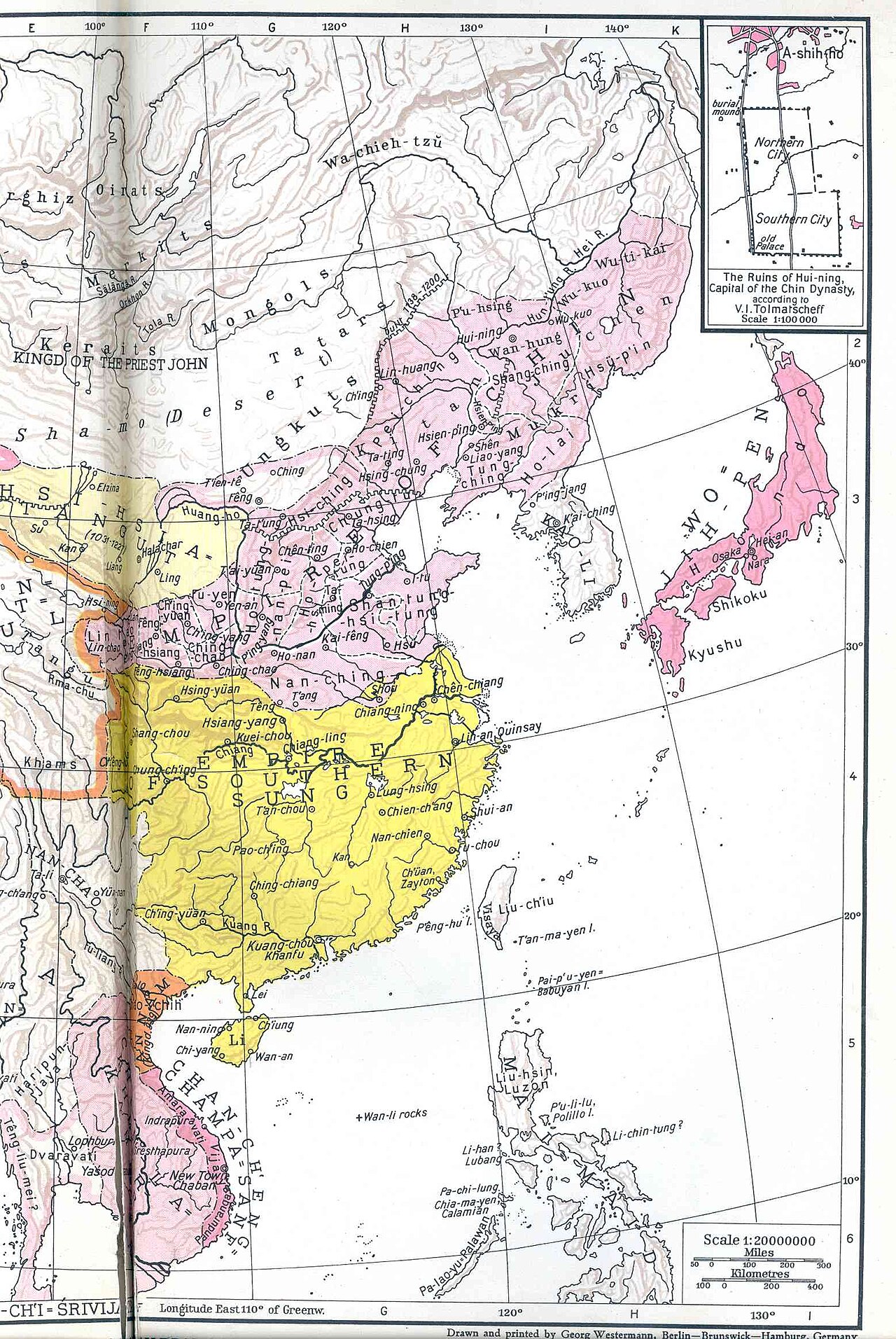
The Jin, Southern Song and Western Xia around 1141. Shandong lies in the east of the Jin, north of the Huai River. Source: Wikimedia Commons, Albert Herrmann & Georg Westermann, public domain

Third, the officials themselves knew the resentment. In 1215 (the third year of Zhenyou), the court wanted to measure land in Henan to settle military families moving south. The censor Liu Yuangui submitted a memorial:
Earlier, in Hebei and Shandong, this was done, and the people's graves, wells and hearths all became the army's; grievance and lawsuits have not ended to this day. If it is done again, we shall lose the hearts of the people. (my translation)
The court listened and called off the measuring.
I stayed on one line a long time: "the people's graves, wells and hearths all became the army's." Graves, wells, stoves: all gone to someone else.
1214, Linzi
Now back to Yuan Haowen.
In 1214 the Mongols attacked from the north, and the Jin moved its capital from Zhongdu to Nanjing (Kaifeng). That year Shandong fell into disorder. Yuan Haowen later wrote a spirit-way inscription for a man named Wanyan Huaide, and the inscription describes exactly this year:
In the second year of Zhenyou, his term was nearly up. But the central lands were at war and bandits filled the roads, linking up in bands of tens of thousands, taking towns and counties, and the government troops could not stop them. Their chiefs stood proudly under grand titles. They hated the cruelty of the land allotments and nursed a grudge against the "seed people," and would not rest until they had killed them. In camps, in scattered homes, in lodgings where they had taken shelter, the rabble rose together to attack, tracing footprints, hunting shadows, sparing no effort; within two or three days, "slaughtered to the last, not a single mouth left." They dug up graves and scattered the bones; it was like this everywhere. (my translation)
In plain words: at the time "bandits" were everywhere, answering each other, tens of thousands strong; towns fell one after another and the army could not control them. Their leaders were brazen, and what they hated was the cruelty of "land allotment"; toward the "seed people," meaning the Jurchen, they would not let one go, determined to kill them all. Whether in barracks, scattered homes, or staying in someone else's house, a crowd rose together, tracked them by their traces, and within two or three days "slaughtered to the last, not a single mouth left." Even graves were dug up and bones thrown away.
That is where the line comes from. It is real, and worse than the reply said: they even dug up graves.
But three things differ from that reply:
One, time and place. It describes Shandong in 1214 (the inscription's subject was magistrate of Linzi), not northern Jiangsu around 1220.
Two, the words "Red Coats" do not appear. The inscription says "bandits" and "chiefs." I linked it to the uprisings of Yang An'er and Liu Erzu in the History of the Jin because time and place match. The History of the Jin says that after Yang An'er and Liu Erzu were defeated, their remnants "kept regrouping, raiding wherever they were, all wearing red padded jackets to recognize one another, and were called the 'Red Jacket bandits.'" That identification is my inference.
Three, the cause: the inscription says it itself, "they hated the cruelty of the land allotments."
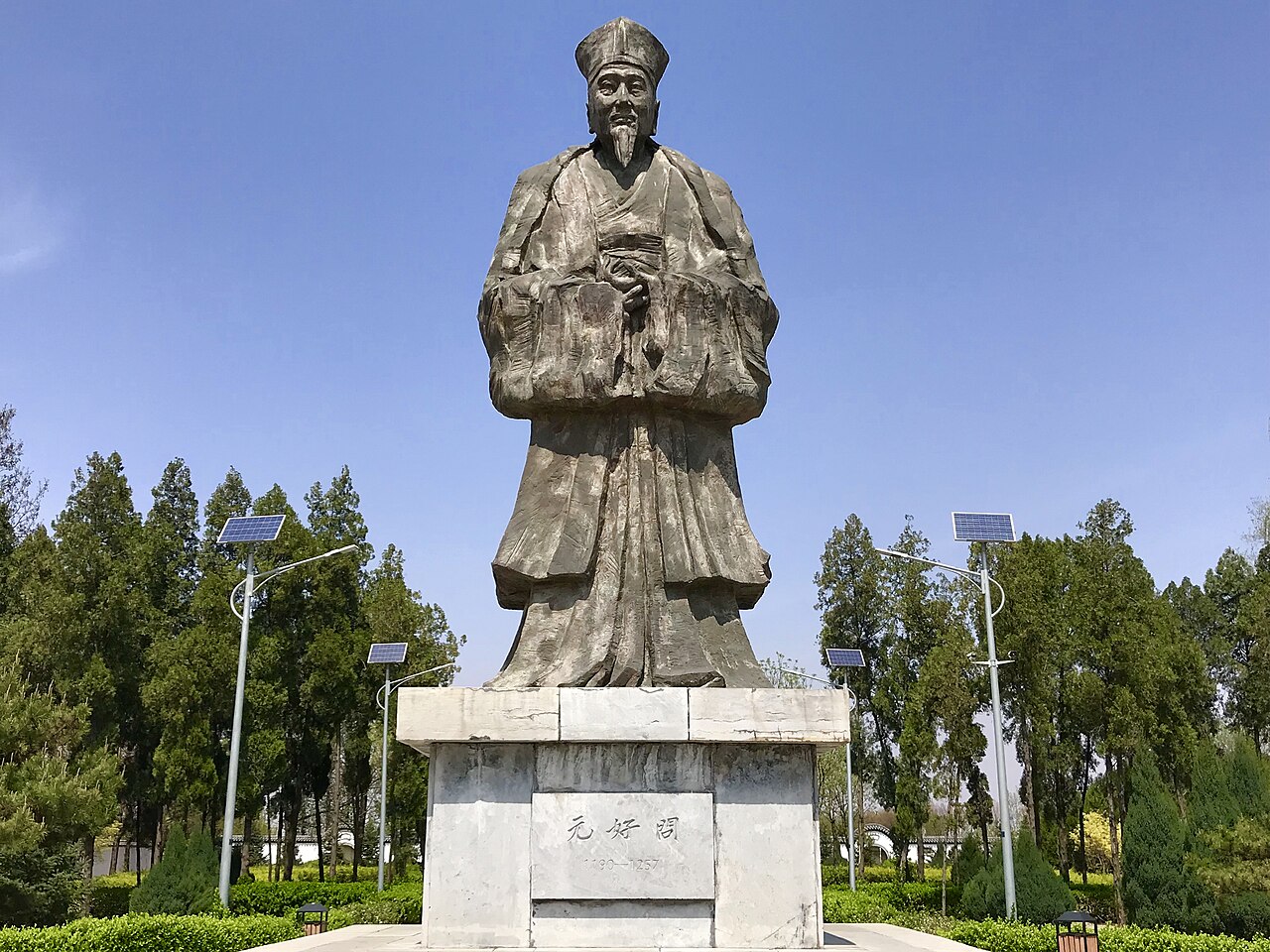
A statue of Yuan Haowen before his tomb in Xinzhou, Shanxi. Source: Wikimedia Commons, Outlookxp, CC BY-SA 4.0

Something else in the same inscription
What that reply did not quote are the lines that follow immediately:
Only the people of Linzi, moved by the magistrate's benevolence, regarded him as their own flesh and blood. They hid him by every means, some whole families, fathers and sons, willing to go to their deaths for it. Once people's minds were settled they did not waver, and the concealment grew only deeper. So it went for months. (my translation)
The magistrate, Wanyan Huaide, was a Jurchen imperial kinsman, assigned in 1213 to be magistrate of Linzi. The inscription says of him: "raised in comfort and wealth, yet he checked himself by law": he did not drink, did not rage, was not petty, did not rule by the whip. Within days, high and low were "cheerful, as if in a single hall."
Elsewhere the Jurchen were killed to the last. But the people of Linzi, "moved by the magistrate's benevolence, regarded him as their own flesh and blood," and hid him, for months. Some were "whole families, fathers and sons, willing to go to their deaths": father and son in one household willing to die to hide him.
Later the commander Pusan Anzhen (the inscription also gives his title, imperial son-in-law) came east with troops, and only then did Wanyan Huaide come out of hiding to see him. He was granted office on the commander's authority but did not want to serve again; he moved south to Bozhou, and died in the twelfth month of 1221, aged sixty.
A magistrate, in the midst of killing everywhere, protected with people's lives. Reading this I thought of the ordinary people swept in, who left no names. Nobody had ordered them to do it.
Then came the suppression
A story can't be told by half. On the Jin side, people were killing too.
The History of the Jin, in the biography of Pusan Anzhen, says that two years later, in 1216 (the fourth year of Zhenyou), he sent troops against Hao Ding, "won every battle, killed ninety thousand, and over thirty thousand surrendered." That is the Jin's own battle report; the numbers can't be checked, and the biography does not separate rebels from others caught up. Next: "Hebei lay broken, with war following war," and remnants of the Red Coats rose again under other names; the History of the Jin names a few, "roughly all followers of Li Quan, Guo Yongan and Shi Qing."
Yang Miaozhen was Li Quan's wife. In the History of the Song, biography of Li Quan, she later said to her men: "Twenty years of the pear-blossom spear, no rival under heaven; now the tide has gone and I cannot hold." Qi Jiguang, in the Jixiao xinshu, scroll 10, "General Remarks on the Long Spear," writes: "The art of the long spear begins with the Yang family, called pear blossom, and all under heaven honor it," and also cites "twenty years of the pear-blossom spear, no rival under heaven."
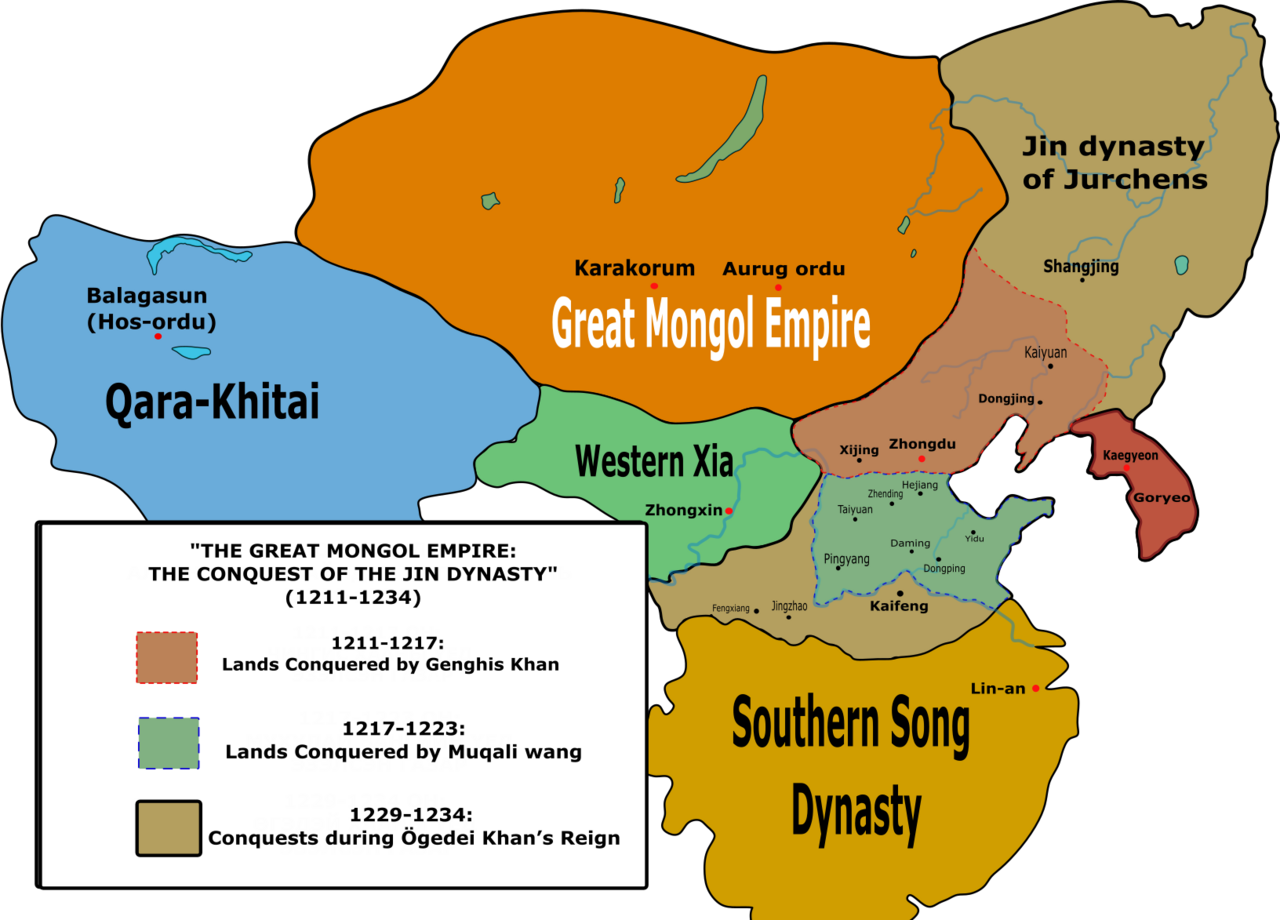
Map of the Mongol–Jin war (1211–1234). Source: Wikimedia Commons, Megzer, CC0

So, "did they live well"?
Back to the question: did the Han under the Jin live better than under the Song?
I can't answer. For concrete reasons:
First, there are no comparable numbers. I found no data that puts Jin Han and Southern Song commoners on the same scale. What I can find are a few lines of historians' eulogy, a few words from an emperor, a few officials' memorials, one inscription. Each is a fragment.
Second, "well" depends on who, which generation, which place. In the Dading years (Shizong), Hebei and Shandong were relatively calm and historians praised it as "Little Yao and Shun." In the Zhenyou years the Mongols came, the Jin moved south, and land measuring, conscription and heavy levies piled up; in one night Shandong fell apart. One court, thirty years, two different pictures.
Third, what can be seen is a process. At first, a system: Jurchen with light corvée, Han with heavy; land measured for the Jurchen, with graves, wells and hearths going to others. That was a matter of land and labor. Later, in a time of chaos, it turned into "nursing a grudge against the 'seed people,' and not resting until they were killed," into ethnic bloodshed. In the inscription, "the cruelty of land allotment" and "seed people" are written side by side.
I don't want to conclude from this that anyone is born a certain way. What can be seen is: first a line drawn by a system, and later, in chaos, people killed along that line.
Turning it around
I'll pick some faults in my own account.
One, Yuan Haowen wrote an inscription praising a Jurchen magistrate. Such an inscription naturally picks the good things, and the story of "only the people of Linzi" would be made to stand out. I have no second source to confirm it.
Two, I did not find the scene of "northern Jiangsu around 1220." That reply tells it vividly, but I found no first-hand record. That doesn't mean it didn't happen; what I read is 1214 Linzi.
Three, the Han also had paths upward under the Jin. The Jin had examinations, and Han could be officials. I have no figures on this, so this piece doesn't cover it. The corvée and land seizure above are only one side of the Jin.
What I think
Reading it through, two images weigh on me most.
One is the graves being dug up. "They dug up graves and scattered the bones." Whoever's graves they were, to dig them up is to pull out the root of a family. I do not want to find an excuse for that act on any side.
The other is Linzi. In the killing all around, a Jurchen magistrate was hidden for months by Han villagers at the cost of their lives. They had read no theory of nations; they simply felt this was a "benevolent" man, "regarded as their own flesh and blood."
I keep saying that what I want is not the identity of one nation but a culture and a belief that everyone shares. These two images make me believe it more: what lets a person live is not which "seed" he belongs to, but what kind of person others recognize him to be.
So what I care about more is this: in a society, are there some things that everyone recognizes, whoever you are? If there are, then in those months in Linzi a few more people will live; if there are not, then who is Han and who is Jurchen, at the edge of the blade, makes no difference.
If you were a household in Linzi that year, would you have opened the door?
References
- Yuan Haowen, "Spirit-way inscription for Wanyan, magistrate of Linzi," Yishan ji, scroll 28 (second year of Zhenyou, 1214), Wikisource, checked word for word 🟢
- History of the Jin, scroll 102, biography of Pusan Anzhen: "after the defeat of Yang An'er and Liu Erzu... all wearing red padded jackets to recognize one another, called 'Red Jacket bandits'"; "killed ninety thousand, over thirty thousand surrendered" (fourth year of Zhenyou), Wikisource, checked word for word 🟢
- History of the Jin, scroll 47, Treatise on Food and Goods II: the land-measuring passages, Shizong's "I hear that the land-measuring was done most improperly," "the stripped people's fields in Shandong had been given to Jurchen military-farm households"; the memorial of Censor Liu Yuangui, third year of Zhenyou; Wikisource, checked word for word 🟢
- History of the Jin, scroll 46, Treatise on Food and Goods I: "Apart from serving their own meng'an and mouke, the Jurchen have no labor service," Wikisource 🟢
- History of the Jin, scroll 8, Annals of Shizong II, comment: "called 'Little Yao and Shun,'" Wikisource 🟢
- History of the Jin, scroll 44, Treatise on the Military: meng'an and mouke living mixed among Han lands, Wikisource 🟢
- Qi Jiguang, Jixiao xinshu, scroll 10, "General Remarks on the Long Spear," Wikisource 🟢; History of the Song, scroll 477, biography of Li Quan II (Yang: "twenty years of the pear-blossom spear, no rival under heaven"), Wikisource 🟢; on the lives of Yang Miaozhen and Li Quan: History of the Song, scrolls 476–477, and the Xu zizhi tongjian, fragments only 🟡
- Online discussion on the topic (netizens' views, a lead only)
- Not found: comparable data on living standards of the Jin Han and the Southern Song commoners; a first-hand record of Red Coats killing Jurchen in northern Jiangsu around 1220
- For comparison: the author's check notes (privilege and ethnic consciousness); in Yigui, "The World Calls Us by Other Names, and None of Them Is 'Han'"; in Neighbours' Heavens, "After the Queue Is Cut, What Do We Wear?" and "Six Similar Exam Papers" (how a system draws ethnic lines)
- Image credits are in each caption