Most of the earlier pieces in Yigui ask: what holds a civilization together? The Southern Chapter asks it from another side: when people scatter and gather again somewhere else, what do they carry with them? I put it in Hunan and Jiangxi, and follow the migration routes, which will also lead to Sichuan, the two Guangs and Fujian.
First, a small thing. If you are from Hunan or Jiangxi, or your ancestors left those two provinces, you have probably heard the sentence: "our family came from Jiangxi." Many genealogies say so. I want to start from that sentence.
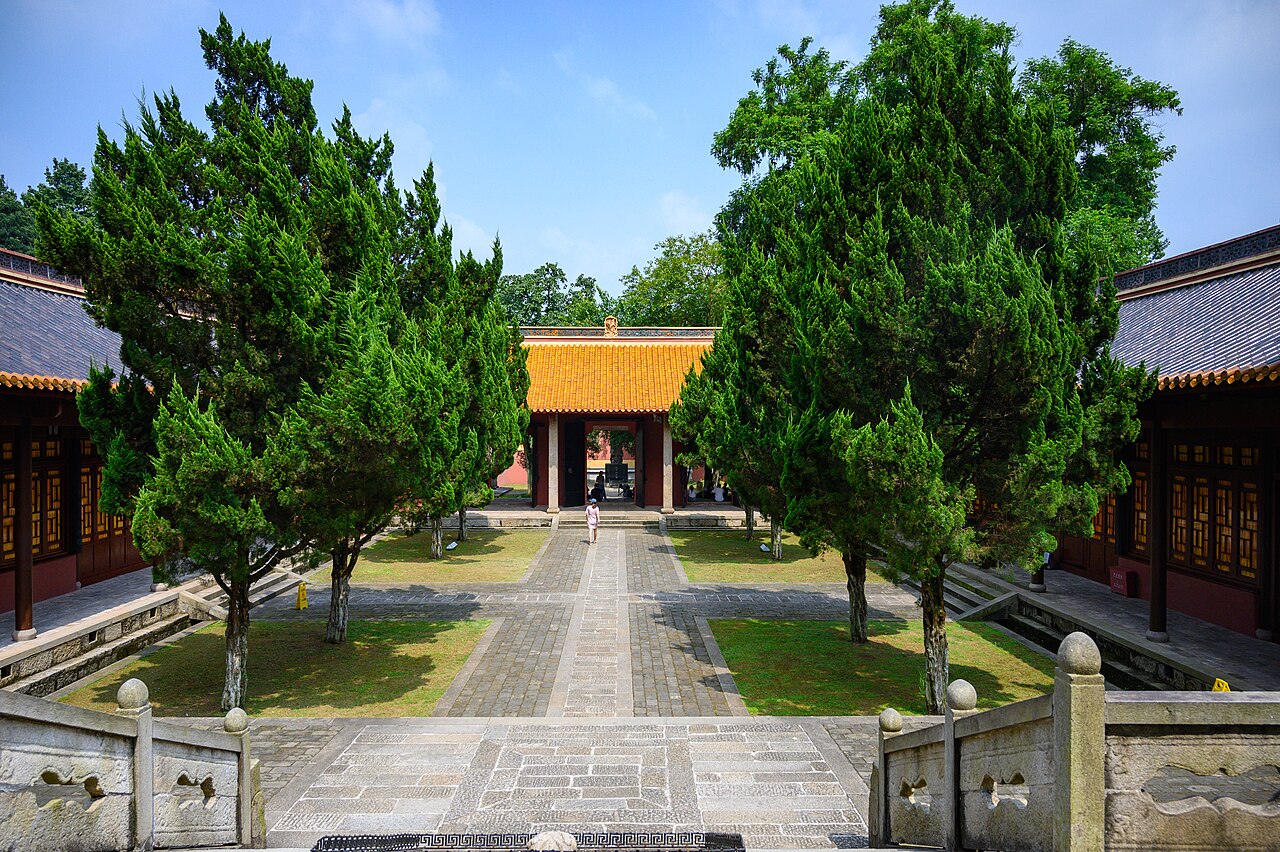
Yuelu Academy in Changsha, founded in 976. Source: Wikimedia Commons, xiquinhosilva, CC BY 2.0

Two thousand years ago, it was one whole
When Sima Qian wrote "The Biographies of the Money-Makers" in the Records of the Grand Historian, describing the customs of the whole realm, he put "Hengshan, Jiujiang, Jiangnan, Yuzhang and Changsha" together under one name, "South Chu," and said its customs "are much like those of West Chu."
Hengshan and Changsha are in today's Hunan; Yuzhang is in today's Jiangxi. Two thousand years ago these two lands were one whole with one name.
Later they were split. The name "Jiangxi" is said to come from "Jiangnan West Circuit" of the Tang, in the twenty-first year of Kaiyuan (733): at first it was just the western half of the Jiangnan circuit. "Hunan" is even more direct: it simply means "south of the lake," south of Dongting Lake. One is an administrative short form, the other a compass direction. (According to Tan Qixiang and others in "The Origins of the Names of China's Provinces": in 733 Jiangnan Circuit was divided into east and west circuits, the western one abbreviated as "Jiangxi Circuit," and "Jiangxi" became a district name; the name "Hunan" began with the Hunan Surveillance Commissioner set up after the An Lushan rebellion, who governed the Xiang and Zi river basins south of Dongting Lake.)
On one side of this land are the Luoxiao Mountains; on the other, two great rivers and two great lakes: the Xiang River and Gan River, Dongting Lake and Poyang Lake. Where people could go from here, which way, was largely decided for them by water and mountains long ago.
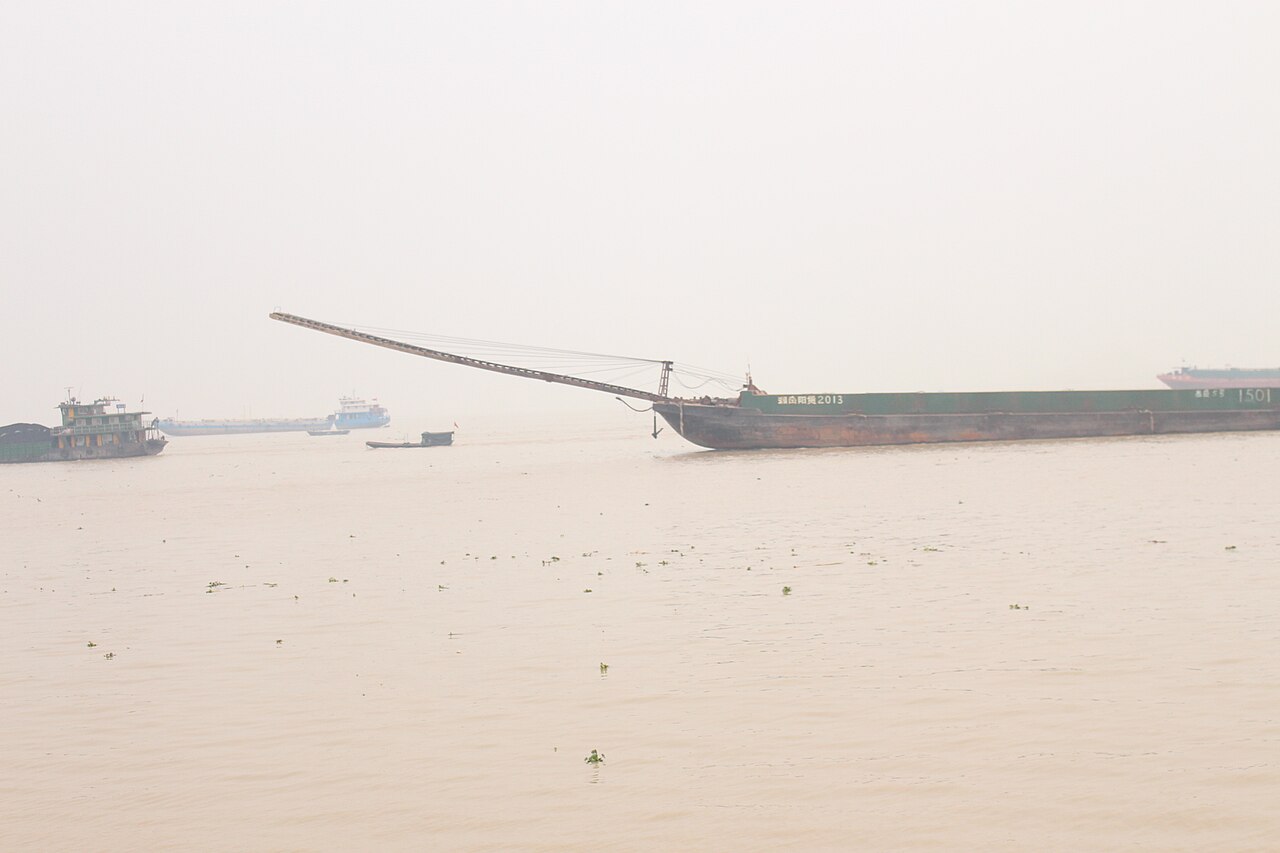
Dongting Lake at Yueyang. Source: Wikimedia Commons, Huangdan2060, CC BY 3.0

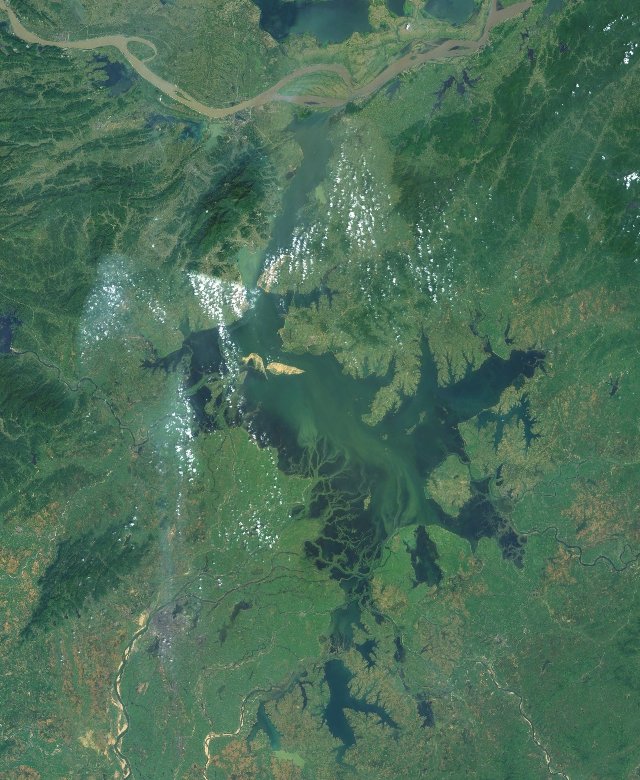
Satellite image of Poyang Lake. Source: Wikimedia Commons, NASA, public domain

One thing I want to ask: how did people move?
The main thread of the Southern Chapter is a plain one: the movement of people.
We often think that being "from somewhere" is a fixed matter. But open the history of Hunan and Jiangxi, and you find that nearly everyone is "from outside." In the late Yuan and early Ming, Hunan's population fell sharply, and Jiangxi people went west in wave after wave, giving rise to the saying "Jiangxi fills Huguang." In the early Qing, Sichuan was short of people, and Hunan people went west in wave after wave in turn, called "Huguang fills Sichuan." Wei Yuan has a line that is said to be about exactly this: after things settled, "Jiangxi people entered Chu, and Chu people entered Shu." (Many papers cite this line as Wei Yuan's "On Water Conservancy in Huguang," about the migration after the Zhang Xianzhong turmoil of the late Ming; I haven't obtained the original text, so I can say only that it is second-hand.)
So I want to put this into history and test it: should people move?
My own leaning is yes. A person shouldn't be locked into the registered origin, the town of birth, the address on an ID card. He should be able to go, to reach another place and begin again. This is something I have been thinking about from many angles. I believe that migration out of free will is what shows the civilization of a modern society.
But I also owe it the strongest opposing case: migration is not always free. In the Hongwu years there were official relocations, group after group, marched under guard. Not everyone who went chose to go. Displacement in wartime has nothing to do with "freedom" at all. A person forced to leave home, half of his party dead on the road: that kind of "movement" is not the kind I want.
So the Southern Chapter really asks two questions. One: what kind of movement is good? Two: when a person arrives at a new place, what does he bring?
What I won't write
I'll say up front that there is one kind of thing the Southern Chapter will not write, and will not let in: regional character.
I won't write "Hunan people are like this" or "Jiangxi people are like that." No "Hunan people are stubborn," no "Jiangxi people are honest." Those sentences are easy to say and easy to like hearing, but most of them were passed along, not checked. Even praise I don't want: putting tens of millions of a province's people into a single adjective is unfair to every one of them.
What I want to ask about is institutions, geography, migration and events: what happened in this place, and how those things affected the people living here.
What I won't go around
The Southern Chapter will write about the years after 1927.
The Hunan–Jiangxi border is the starting point of many later big events: the Nanchang Uprising, the Autumn Harvest Uprising, Jinggangshan, Ruijin, the departure of the Long March. I will write these. I will also write about what the countryside of the two provinces went through after 1949. The materials I read include official figures, local gazetteers, scholars' studies and the memories of those who were there. I will lay them side by side, each in its own terms.
I'll check facts as carefully as I can. Judgments I will write as judgments, not mix them into facts. I do have views on the Communist Party and on communism, and I don't intend to pretend I don't. But I also don't want to write a view as if it were a fact. I'll hold to that distinction throughout.
This site is for readers outside mainland China, and I also want to use the chance to say, a little more clearly, many things that are hard to say inside the wall. But what I want is to say them accurately, not to say them heavily.
What we'll look at next
Roughly these things:
- Start from "South Chu": the pottery shards of twenty thousand years ago, rice of more than ten thousand years ago, Shang bronze, Qu Yuan and Jia Yi;
- then a road cut in the Tang that carved out a Jiangxi; Chan Buddhism's "travelling the rivers and lakes"; Zhou Dunyi, Zhu Xi and Zhang Shi at Yuelu Academy, Zhu Xi and Lu Jiuyuan at Goose Lake;
- then "filling" and "going": Jiangxi filling Huguang, Huguang filling Sichuan, how to read a genealogy, Jingdezhen and the Jiangyou merchants;
- then Zeng Guofan and the Hunan Army, statecraft, and the many claims about "why Hunan produces talent," and which of them stand up to checking;
- then the Hunan–Jiangxi border after 1927;
- and finally, the present: the two provinces' accounts, five million Hunanese in Guangdong, falling births in both provinces, and the question I most want to ask: should people move?
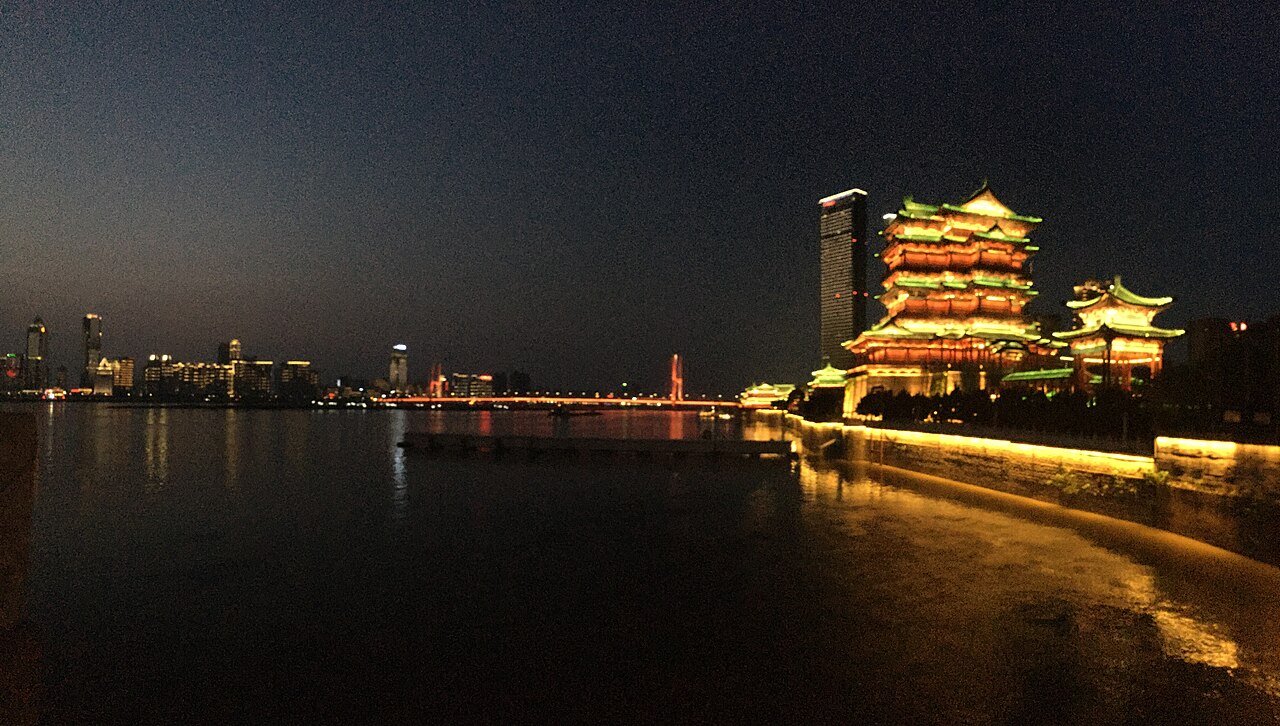
Tengwang Pavilion in Nanchang. Wang Bo wrote in his "Preface to the Tengwang Pavilion" that it "girdles three rivers and belts five lakes, commands the wild Jing and draws in Ou and Yue." Source: Wikimedia Commons, Ashish Yadav, CC BY-SA 4.0

Looking the other way
The Southern Chapter's premise has three hard opposing cases.
First, the "movement" I talk about may sound too nice. The official relocations of the Hongwu years and flight in wartime were not free movement. Putting them in one basket called "movement" with a young person today taking the high-speed train to Guangzhou for work: could that be switching concepts?
Second, genealogies are the material I most like to quote and also one of the least reliable. Genealogies reach for prestigious ancestors, they get altered, and the writers are often families who did well later. "Our ancestors came from Jiangxi": part of that may be true, and part is just what everyone writes.
Third, regional narratives easily turn into stereotypes. I want to avoid that myself, but I am not sure I won't slip into it when I write about the Hunan Army and the modern period. If you read a passage and think I have slipped, please tell me.
Has an elder in your family also said, "Our family came from somewhere else"? Where was that somewhere else?
References
- Records of the Grand Historian, "The Biographies of the Money-Makers": "Hengshan, Jiujiang, Jiangnan, Yuzhang and Changsha are South Chu, and their customs are much like West Chu." (Wikisource)
- "Jiangxi" named from the "Jiangnan West Circuit" of the twenty-first year of Kaiyuan (733), and "Hunan" from the Hunan Surveillance Commissioner of the mid-to-late Tang: Tan Qixiang et al., "The Origins of the Names of China's Provinces," reposted on Aisixiang 🟡
- Wei Yuan's "Jiangxi people entered Chu, and Chu people entered Shu" in "On Water Conservancy in Huguang": seen cited in many papers (e.g. Zhang Guoxiong, "The Main Directions and Periods of Migration in Chinese History," Journal of Peking University 1996, no. 2); the original book has not been obtained 🟡
- For comparison: the pieces in Current Affairs on "should people move"; the Housing chapter of Yigui (mansions, ancestral halls, genealogies and ancestral graves in central Hunan)
- Image sources are given in each caption