When I was small I heard an elder say one thing: when they opened Nanjing, they brought in foreign wealth.
The person who said it wasn't doing scholarship. It was said at a dinner table, under the eaves, in passing, and it meant: those big houses around our parts were built with money brought back from Nanjing. I have always remembered that sentence.
Let me put my cards on the table first: I lean toward believing it.
Why I believe it: someone was there
Zhao Liewen was Zeng Guofan's staff adviser. On the twenty-third day of the sixth month of the third year of Tongzhi, that is 26 July 1864, he wrote a diary entry about Nanjing after the city fell. I have read the original, word by word.
Of the able-bodied Taiping soldiers, apart from those killed in the resistance, not many died; most were seized by the troops to carry loads out of the city, or taken to dig up cellars, and let go once they'd dug. The old and weak, those who could not carry a load and had no cellar to dig, were "killed at will," and along the streets, nine of ten corpses were old people. Women under forty: not one left. Writing that, he put down four characters: "enough to make one's hair stand on end."
Zeng Guofan's proclamations were pasted all over the city, forbidding the killing of civilians and the seizing of women. But of several commanders, Zhao named them: Peng Yuju, Yi Lianghu, Peng Chunnian, Xiao Fusi and Zhang Shiri: "they know only plunder and never obey." He also says that Xiao Fusi took gold and silver out of the Heavenly King's palace, "beyond counting," and then set the buildings on fire to burn away the traces.
This is the hardest thing I have. There was large-scale looting in the city; some people really did get things; and some people feared leaving traces. Zeng Guofan himself, in a memorial, is quoted as saying there were "no goods at all" in the city, but he was a participant, and I have only a second-hand quotation, so I take that line as a lead and nothing more.
The ledger: I'm done chasing it
How much was taken out, who took it, how it was carried home: I went through everything I could find, and could match not one entry.
I've thought about it, and I don't plan to chase it further. The people at the time didn't keep accounts, and if they had, they would not likely have left them. For a matter nobody wrote down, thousands of words arguing "did it or didn't it" produce nothing. Besides, the money need not have had a single source: rank and salary earned through the war was one route, buying land and property after the war another, gifts and exchanges back in the home district a third. "Foreign wealth" in Chinese is a common phrase for windfall money; it does not have to mean money from foreigners.
More important than the ledger is what this money, whatever the amount, finally became.
It became houses
A Hunan Daily report of 2022 says that around Yangshi Town and Sanjia Township in Lianyuan, Loudi, together with Shuidongdi Town in Louxing District, there survive well over a hundred old residences of Hunan Army generals, of which 17 are fairly well preserved and 7 are provincial heritage sites. The figures are the report's; I did not count them myself. A local article on the Yangjiatan area says that these officers, "returning home in glory," built on a large scale, which is how the rows of mansions came to stand there.
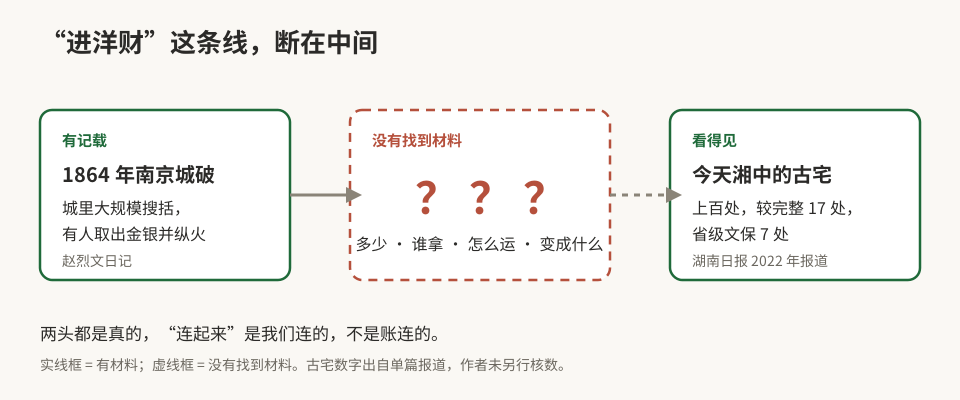
The elders told me another half. Two fellow villagers served in the same army. One kept his wealth and built a great house; the other, in the elder's words, "couldn't keep money, only spend it." That is oral testimony with no written source, and I take it only as something people say. But it puts a question on the table: the same money, in one man's hands, turned into a house that stood for generations and, more than a hundred years later, became a protected site; in another's it was spent, and his descendants had little to tell.
Zeng Guofan himself, around 1849, before the fighting, wrote to his younger brothers that after the age of thirty he counted "making an official career and a fortune" as shameful, and that any money he had should first go to relieve the poor of his clan. That was the rule he set for himself. How his subordinates behaved is another ledger.
It became people leaving
The Hunan Army's march out of Hunan was a large outflow of people. Hunanese went to Jiangxi, Anhui, Jiangsu; some came back, with rank, with reputation, perhaps with money; some never came back.
Those who came back put money and name in the old place: houses, ancestral halls, academies, and the confidence of generation after generation of scholars who left. I found no data to say that cultural life in Hunan after the war surpassed what came before. Yuelu Academy dates to the Song, so Hunan's academies did not begin after the war; on the other hand one study says that from the Ming Hongwu reign to the end of Qianlong, Hunan produced only 1.8 per cent of the nation's jinshi, with no source given. I draw no conclusion from either. I only want to say: the line is real, but it is not a single line.
And then?
The state of those great houses today is not this piece's business. In the series Yigui, the piece on Fuhoutang and Yangjiatan describes how those old houses fell down and were turned into grain stations and factories; in Shishi, the piece on rural Hunan has today's numbers. The houses are empty. That is true.
What I want to say is what comes after the houses are empty.
The Hunan Army took a generation of men out of Hunan and brought a row of houses back. The houses were later emptied; the people never stopped. Today, one in every 13 people with a Hunan household registration is in Guangdong. This is not a bad thing. People should be able to move. "A transplanted tree dies, a transplanted person lives." "Follow the water and grass." To stay in your home place and spend all your strength fighting each other over the same piece of ground is what I'd call involution.
My hope for East Asians is roughly this. People can go and live anywhere in the world, wherever the water and grass are. But they must carry one thing with them, wherever they go: a shared core. Ancestor veneration, ritual, festivals, a Chinese-character text one can read. Able to move, and not scattered; able to hold on, without being squeezed into a little patch of home ground and competing there.
So when I read about this Hunan Army money, I don't look at how much it was or which house it went into. I look at whether the men who left Hunan turned "leaving" into something that could last, or only turned money into houses and left the houses to the emptiness that came after. The southern chapter will keep asking that.
If the money really did come out of that city, did anyone afterwards remember the people in it who could not get out?
References
- Zhao Liewen, Diary from the Studio of Quiet Ability (Nengjingju riji), twenty-third day of the sixth month, third year of Tongzhi (26 July 1864), Wikisource, checked word for word against the original 🟢
- Zeng Guofan to his younger brothers, twenty-first day of the third month, twenty-ninth year of Daoguang (1849), Family Letters of Zeng Guofan, Wikisource, checked word for word; whether the letter's date matches its title is still to be checked, which is why the text says "around 1849" 🟢
- Zeng Guofan's memorial on the recapture of Jinling: roughly "there was no so-called storehouse… no goods at all"; second-hand, memorial title and date not checked 🟡
- Hunan Daily, 13 January 2022, p. 8, "Old Houses in Central Hunan Stir Nostalgia" (reposted by Voice of Hunan), on surviving mansions of Hunan Army generals (over a hundred; 17 fairly well preserved; 7 provincial-level heritage sites): original read, numbers are the report's and not independently counted 🟡; local article on Yangjiatan (Voice of Hunan, 2017) 🟡
- Yuelu Academy founded 976 (the ninth year of Song Kaibao), Zhu Xi's visit and joint lecture with Zhang Shi in 1167 (third year of Qiandao), Zhang Shi invited to teach around 1166: Chinese Wikipedia, "Yuelu Academy" 🟡; 710 Hunan jinshi from Ming Hongwu to the end of Qing Qianlong, 1.8% of the national total: Shen Dengmiao, Hu-Xiang Forum, 2000, no. 3, reposted on Aisixiang; the original source of the count is not given in the article 🟡
- Another often-cited Zhao Liewen diary line, "greedy for plunder, rather disorderly in ranks, the troops of the central army who stayed in camp all went out to loot": cited via Guo Tingyi, Outline of Modern Chinese History; date not checked 🟡
- The figure in this piece is a schematic diagram drawn by program, not a historical source